Leadership & Decision-Making workshop
A facilitated workshop for executives and leadership teams who need clearer decision rules, explicit trade-offs, and the confidence to act under uncertainty.

01
Executives, team leaders, and decision-makers who share responsibility for key choices.
02
Two days in person or a four-week online programme, tailored to your leadership challenge.
03
Six Thinking Hats, Scenario Planning, and Rapid Decision Frameworks, adapted to your context.
04
In person or online for teams, organisations, institutions, and leadership groups.

The challenge
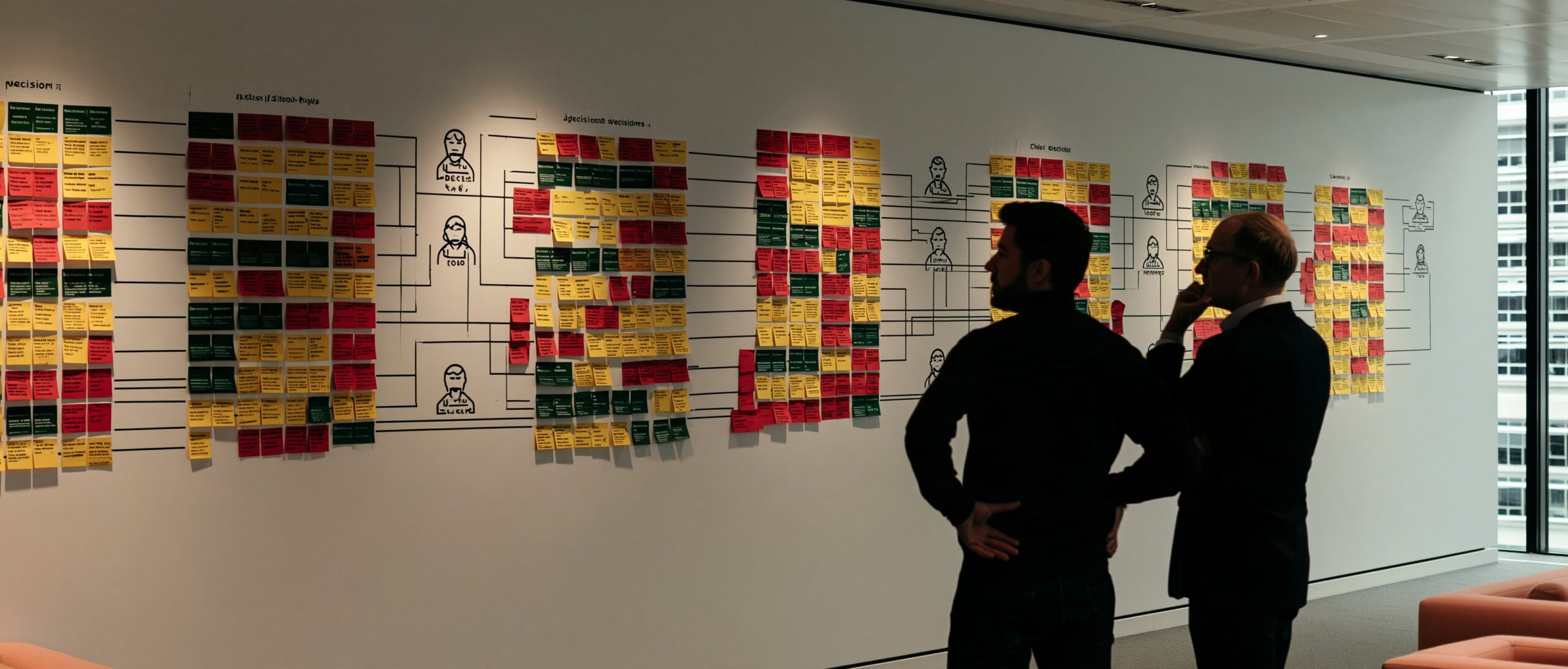
When decisions stall, the cause is rarely one person. It is unclear priorities, hidden trade-offs, vague decision rights, and too little room for structured disagreement. This workshop treats leadership as a system and makes those conditions visible, so your team can decide how it decides.
✓
A structured session to clarify decision rights, criteria, and trade-offs, and to practise deciding together on real cases.
×
Not a personality assessment, a motivational talk, or a generic leadership training.
Why it works
01
Thinking tools give every perspective a role, so challenge becomes useful rather than personal.
02
Hidden trade-offs slow strategy down. Naming them makes difficult choices discussable.
03
Everyone knows which decisions are theirs, which are shared, and who has the final say.
04
Exploring several possible futures prepares leaders to act when conditions change.
Process
01
We define the strategic challenge and the decisions that keep getting stuck.
02
Leaders map current behaviours, decision bottlenecks, and who decides what.
03
Assumptions and trade-offs are made explicit and examined together.
04
Scenarios test how decisions hold up under different futures.
05
Decision criteria and rights are agreed and practised on real cases.
06
Execution mechanisms and review points keep the new way of deciding alive.
In practice
Leaders in the room

Decisions made visible

Thinking under pressure

Outcomes
01
A clear view of which decisions belong to whom, and where they currently get stuck.
02
Shared criteria for the choices that matter most to your strategy.
03
A practical, structured framework leaders can use on the next difficult call.
04
The key tensions named, discussed, and owned rather than avoided.
05
A small set of scenarios and the signals that would trigger a change of course.
06
Concrete actions, owners, and review dates to put the new way of deciding into practice.

Facilitated by
I’m Christian Vernaschi, founder of From Ideas to Impact. I combine more than 20 years in creative strategy with facilitation, Design Thinking, brand strategy, and leadership development. My work focuses on helping teams move from vague alignment to visible decisions they can actually act on.
Christian Vernaschi, Trained Certified Facilitator of LEGO® SERIOUS PLAY® method and materials
FAQ
Executives and leaders who share responsibility for key decisions: a leadership team, a management team, or decision-makers across functions.
We start with a short conversation about the decisions that matter, where they get stuck, and who is involved. No previous experience with the methods is needed.
Only when it fits. The core methods are thinking and decision frameworks; LEGO® SERIOUS PLAY® can be added when a team needs to surface tacit assumptions or give every voice equal weight.
Yes. The in-person version typically runs over two days; the online version is spread over about four weeks of shorter sessions.
You receive a synthesis of the decisions, criteria, and actions agreed. A follow-up session can be added to review how the new way of deciding works in practice.
Not in the classic sense. It works on how your team actually decides, using your real decisions, rather than teaching generic leadership skills.
When decision rights, criteria, and trade-offs are clear, leaders can move with confidence. That is when leadership stops being a title and starts becoming a system.
Articles
19/10/2026
Every assumption gets tested eventually. Most organisations only own the expensive version: build it, launch it, find out. The cheap version is
Read more
19/10/2026
Ask a student to explain their concept and they describe it. Ask them to explain the metaphor they chose and they often
Read more
18/09/2026
Every assumption gets tested eventually. Most organisations only own the expensive version: build it, launch it, find out. The cheap version is
Read more