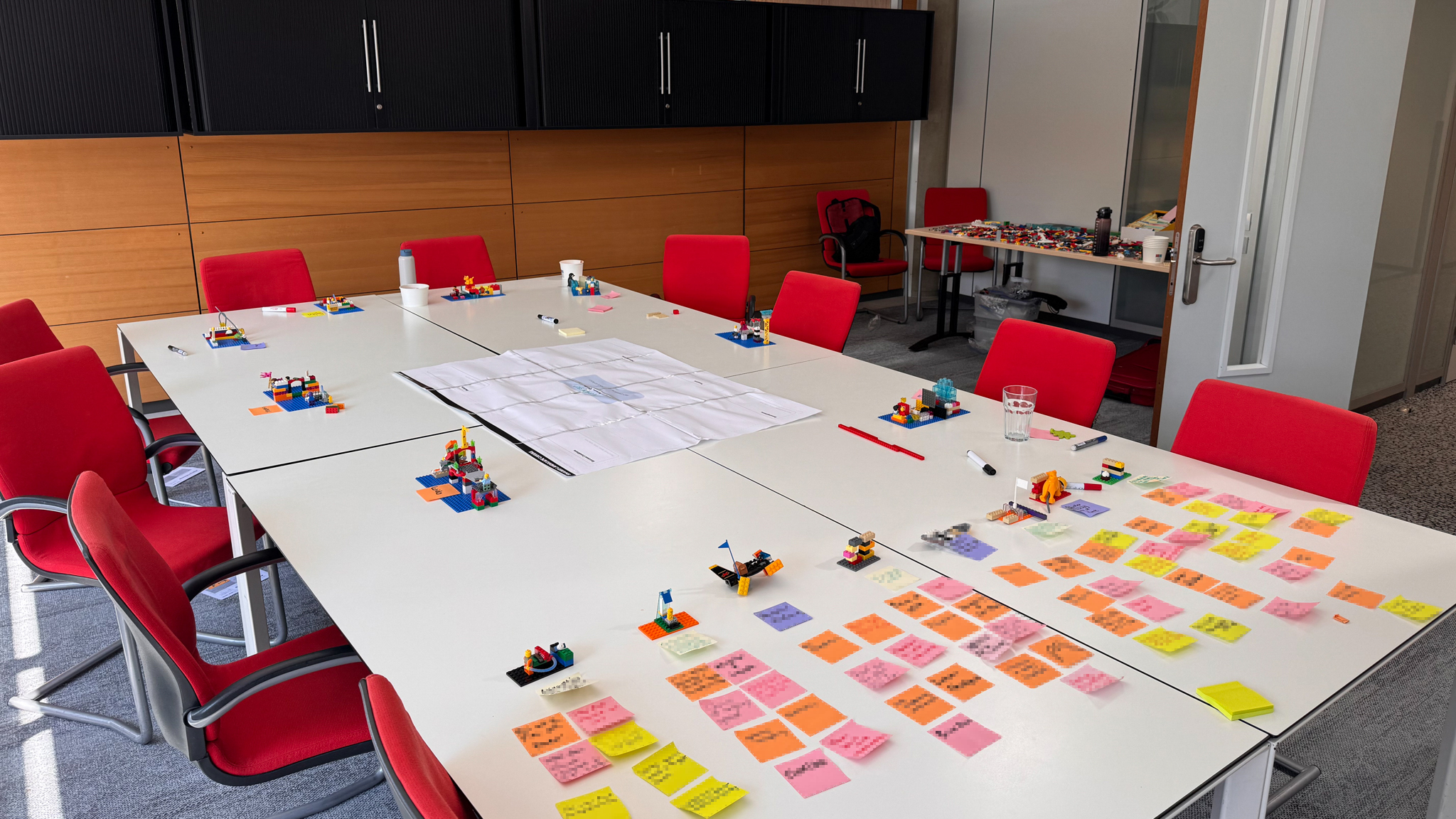
Someone built a small figure running against a clock, with an hourglass beside it.
Asked what it represented, they said the deadline was real. Then they said nobody had ever defined it.
That combination is worth stopping on. A deadline you can name is a constraint, and constraints can be planned against. A deadline that exists but has never been stated cannot be managed at all. It can only be feared.
Everyone in that room had been working under it for months. Nobody had said it out loud, because saying it means admitting the company is running against a clock that nobody has read.
The sentence took four seconds. It had been available for a year.
Two tests, two currencies
Every assumption an organisation holds gets tested eventually. That is not a risk, it is a certainty. The only variables are when, and what has already been spent by the time it happens.
Most organisations run one kind of test, and it is the expensive one. Agree something in a room, build against it, take it to market, find out. The feedback is excellent. It is also the costliest feedback available, because by the time it arrives the budget is committed, the roadmap is public, and somebody’s name is attached to the answer.
The cheap test is available the whole time. Ask the question early, in a room where people have to respond. It costs an afternoon.
So the useful question is not how to run the cheap test. It is why almost nobody does.

Because certainty is load-bearing
The standard explanation is that organisations do not notice. Everyone is busy, the assumption slips through, nobody thinks to ask.
That explanation is too flattering.
The cheap test takes something from a company that the expensive one does not. The expensive test costs money, and money is budgeted. The cheap test costs certainty, and nothing in an organisation has a line item for that.
Certainty is structural. It closes the round. It holds a team through a bad quarter. It gets the roadmap approved and keeps the board calm between updates. A company that says out loud it has been working to a deadline nobody defined has a harder Monday than a company that has not yet noticed.
Which produces a quietly awful incentive. Finding out early is punished. Finding out late is survivable, because by then the situation is complicated, several people own it, and the market can absorb some of the blame.
Nobody decides this. It is simply cheaper, in the currency that actually circulates inside a company, to not know yet.
What agreement is made of
This is where the damage gets locked in, and it happens in rooms that feel productive.
A leadership team works through a strategy. Positions get stated, objections get raised, something gets conceded, and a version emerges that nobody objects to. That version goes into a deck. The deck becomes the decision.
What the deck does not record is why each person stopped objecting. One believes the plan works because the market is moving. Another believes it works because a competitor is distracted. A third has private doubts and decided this was not the meeting. All three approve the same slide.
The deck looks like alignment. It is three theories that happen to share a conclusion.
That is decision drift caught before it starts to travel. The decision has not gone anywhere yet and it is already carrying three meanings.

Making it someone's turn
The cheap test is not a longer meeting. More discussion produces more of what discussion produces, which is a conversation shaped by whoever is most fluent and most senior, usually the same person.
It has one requirement. Every person commits to their own account of the problem before the group builds a shared one. Not a reaction to someone else’s account. Their own, made independently, explained in their own words, then questioned.
Reverse that order and the first articulate version becomes the frame everyone else argues inside. Nobody is being dishonest. Groups converge on the first available structure and then defend it, which is usually efficient and occasionally catastrophic.
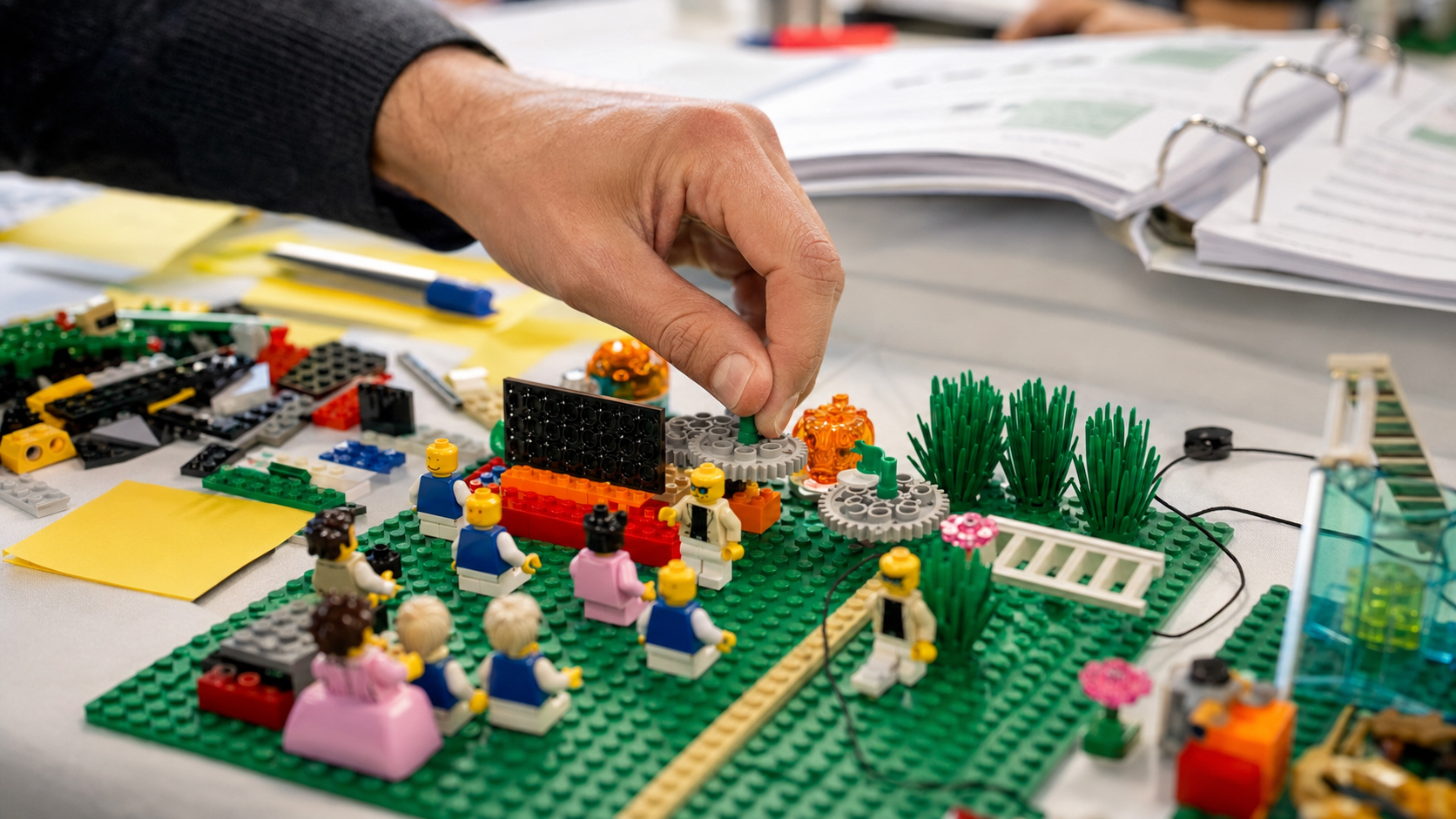
I use LEGO Serious Play because building something and then explaining it forces a precision that talking does not. A metaphor commits you. You have to say what the thing represents, and saying it out loud is often where you first hear your own assumption.
One of the strategists in that room put it plainly afterwards. “I didn’t expect to visualize physically what I thought the problem was.”
That is the mechanism in a sentence. He was not surprised by the conclusion. He was surprised that the thing in his head could become an object on a table, one that seven colleagues could walk around and point at. A thought you hold on your own is difficult to examine, including by you.
The method matters less than the sequence. What matters is that individual reasoning gets externalised and questioned before the group has anything to defend.
What safety is actually for
Their CEO described the change in the room like this: “It became visible that everyone’s opinion is valuable, and everybody can share their view in a safe environment, and everyone could be heard.”
That usually gets filed under psychological safety. I have argued elsewhere that safety is engineered rather than encouraged, so I will not repeat the case here. The part worth adding is narrower.
Go back to the cost problem. Saying out loud that the deadline was never defined is expensive, and people only pay that price in a room that will not charge them for it. Safety is not the benefit. It is the mechanism that makes an expensive admission affordable.
Everything else in that afternoon followed from admissions that would have been too costly to make on an ordinary Tuesday. Not because anyone was hiding. Because on an ordinary Tuesday there is no structure that makes it your turn, and no agreement that the next twenty minutes are for not knowing.
The half of this I have already written
Once those admissions are on the table, a second problem starts immediately, and it is the one that wastes most of the value: the organisation goes back to its normal operating system on Monday and the clarity has nowhere to live.
That problem, and the five translations that solve it, is the subject of a separate article. It is about what survives the room.
This one is about why the room is so hard to book in the first place. The two failures are different and they need different fixes. A follow-up structure will not help an organisation that never convenes the session, and no session helps a company that has no way to carry what it hears.
Both are design problems. Neither is a motivation problem, which is why exhortation does not touch them.
What it actually costs
That company spent an afternoon finding out it had been running against a deadline nobody had written down.
That is not a comfortable afternoon. It is considerably more comfortable than the alternative, which is discovering the same thing eighteen months later in a funding conversation, with a timeline nobody agreed and a room full of people who each assumed somebody else had set it.
The cheap test was available the entire time. What made it expensive was never the hour. It was having to say, out loud and on the record, that nobody knew yet.
What has your organisation been working towards for months without ever having agreed what it is?