A LEGO® SERIOUS PLAY® workshop follow-up turns a shared model into choices, ownership and action that survive after the bricks leave the table.
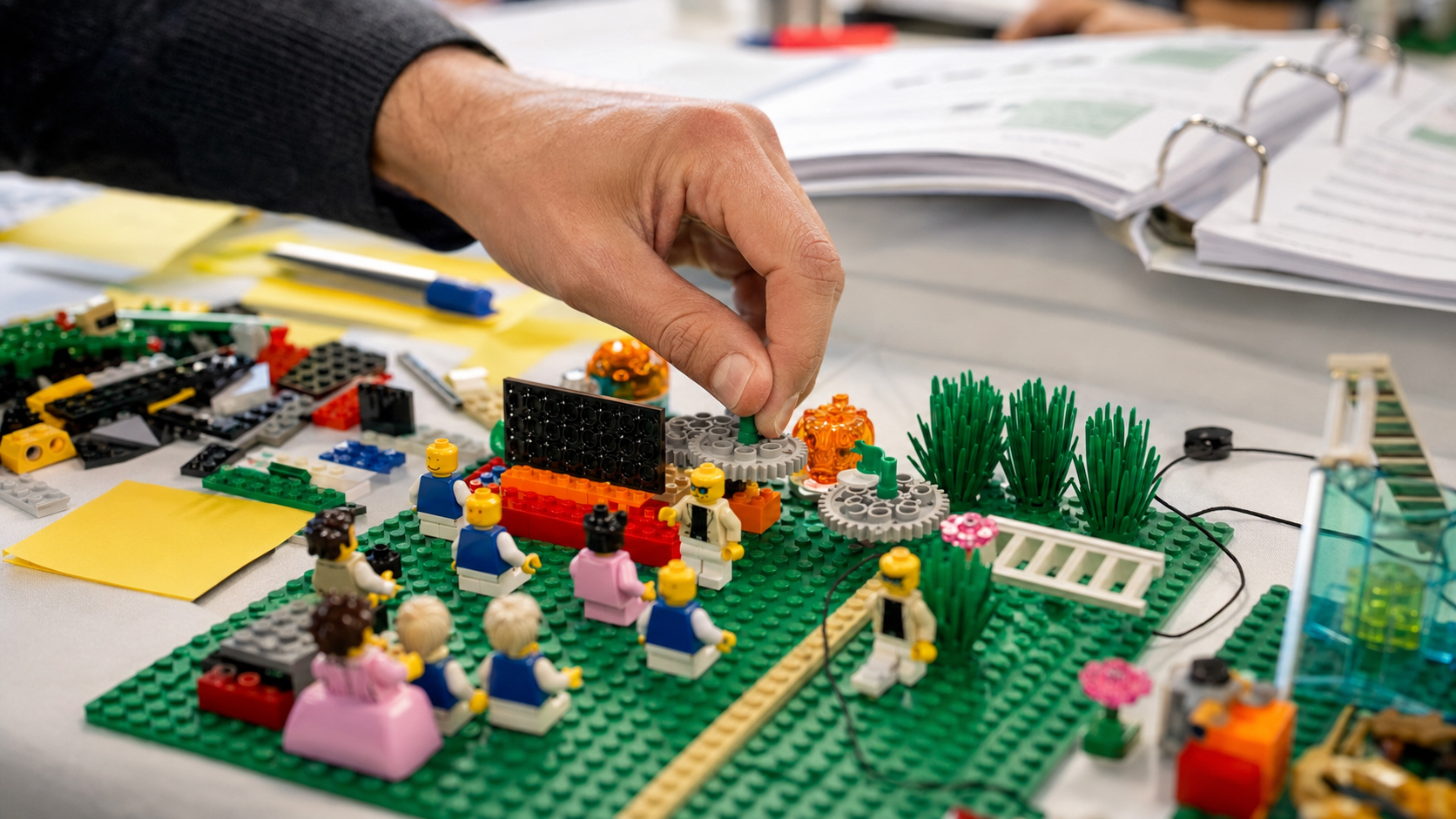
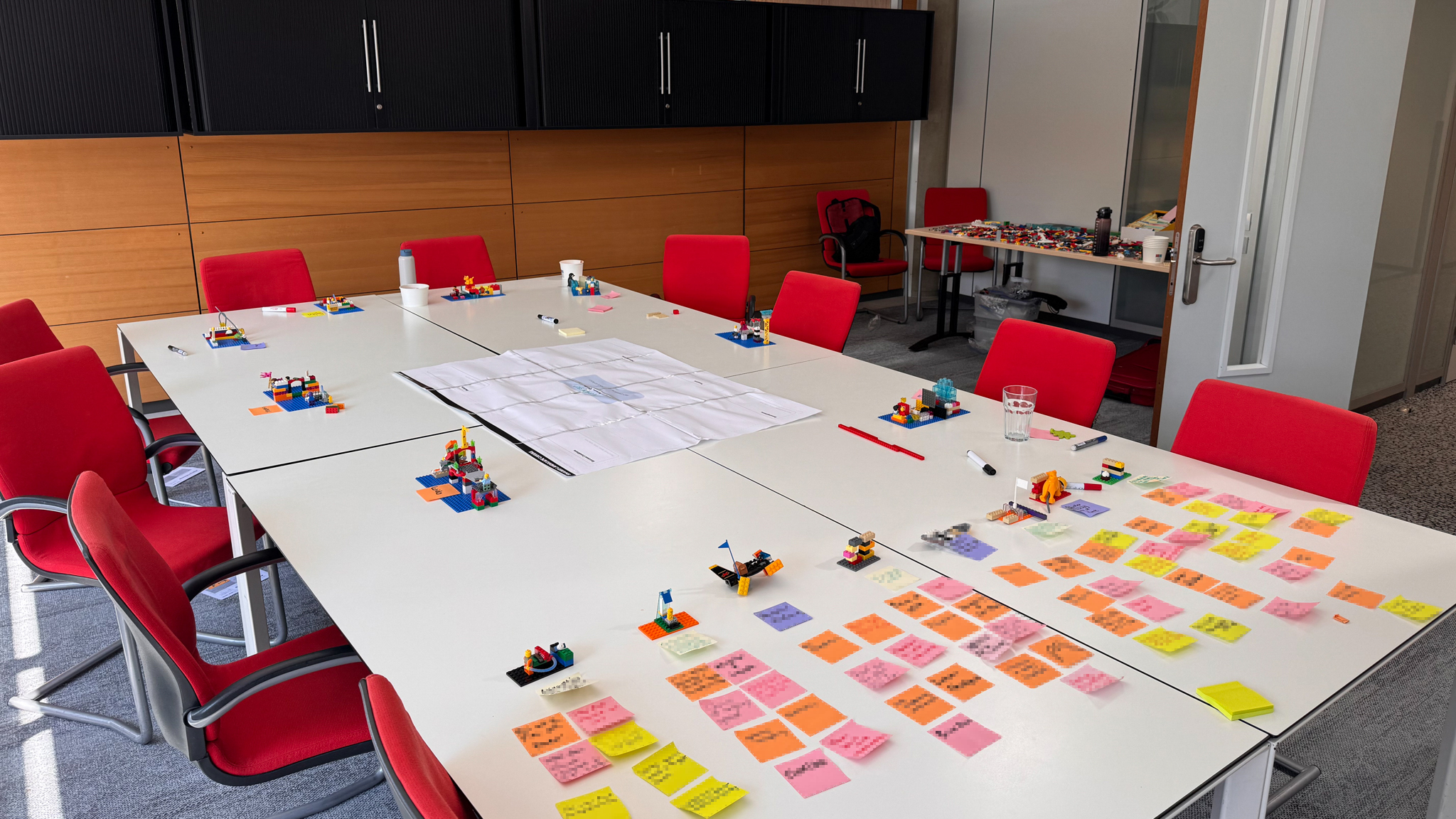
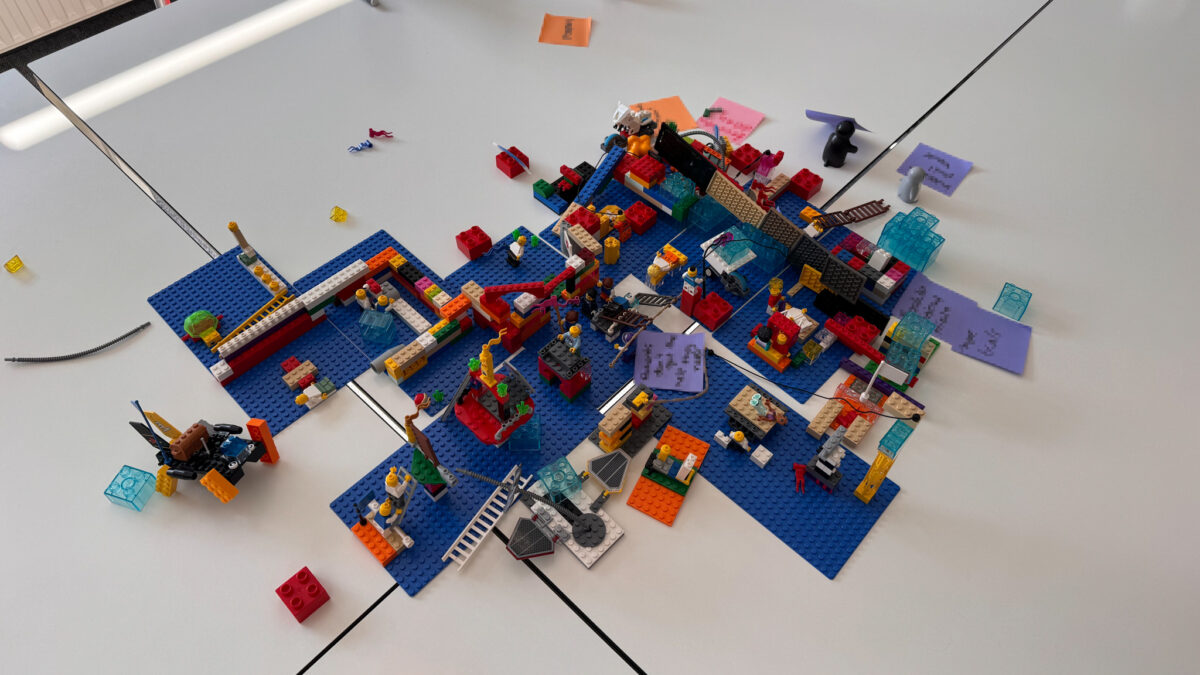
On a recent Friday afternoon, a young company’s full team spent the session building the route to their first market launch. By the end, individual models stood around the table while a shared landscape occupied the centre: the customer’s world in the middle, the company connected to it, and every blocker and assumption placed where it bites.
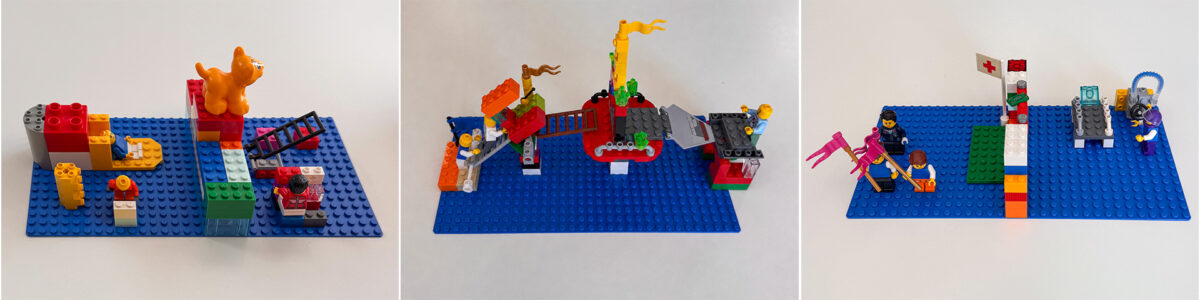
The recurring imagery told its own story. Walls between the company and its future customers. Ladders and bridges built to cross them. Doors that could only be opened from the other side. A product that had to fit through a regulatory gate that might prove too narrow. Connections and dependencies that had lived inside separate conversations were visible in one place, and the team drew its own conclusion: the path to market was not only technical. It depended on someone inside the customer organisation wanting to pull the product in.
That is more useful than a collection of ideas. It is a shared view of the system.
Then the workshop ends.
The bricks will not attend Monday’s meetings. The shared landscape cannot defend itself when priorities start competing again. A photograph preserves where everything stood, but not what any of it meant.
One participant in that session modelled the company’s central risk as a beautiful, fast, treasure-laden car with square wheels: everything about the company can be in order and the product still does not work where it counts. In the photograph, it is an orange car. The meaning exists because the builder explained it and because the group explored that explanation together. Separate the model from its story and the artefact becomes ambiguous. The same applies to sticky notes, canvases and workshop reports: they record what appeared in the room without capturing what the team learned from it.
This is the central risk after a successful workshop. The session creates temporary clarity. The organisation returns to its permanent operating system.
On Monday, participants go back to functional meetings, deadlines, approval structures and established power dynamics. The shared landscape fragments into separate task lists. Dependencies become handovers, assumptions disappear inside project plans, and open questions acquire owners who lack the authority to answer them. People remember different parts, senior voices regain their usual influence, and provisional choices start to sound either more certain or less important than they were.
Alignment rarely disappears because people change their minds. It disappears because the system they return to has nowhere to hold what they saw together.
As explored in Innovation fails when teams cannot think together, the problem is rarely a lack of ideas or enthusiasm. Teams lack a shared structure for moving from collective thinking to decisions. The workshop may have produced genuine alignment. It has not yet produced a structure capable of carrying that alignment forward.
What a serious workshop actually produces
A serious strategy workshop produces more than engagement and less than a finished strategy.
The official LEGO overview of the methodology describes how it encourages everyone to participate, contribute and commit to a solution. The LEGO Group’s open-source introduction explains the principles and philosophy behind the method. Those principles describe what becomes possible inside the room. The follow-up protects that value after the room returns to normal.
In practice, a well-designed workshop can produce:
- Individual interpretations before group dynamics compress them
- A shared view of the system rather than separate departmental views
- Visible assumptions, dependencies and contradictions
- Provisional priorities the team can examine together
A record of the reasoning behind an emerging direction
The session above is a concrete case. The priority the team ranked first at the end of the afternoon was on nobody’s list at the start. It moved from a vague, shared unease to specific gaps and concrete next moves in a single afternoon. And when the team stress-tested its most loaded assumption, that the product performs as expected, and rebuilt the landscape under that scenario, their own summary needed only two words: everything breaks. That sentence did more for prioritisation than any risk register.
These outputs are valuable and deliberately unfinished. The workshop’s job is to help a team see what ordinary conversation leaves hidden. Once that visibility exists, the nature of the work changes: facilitation helps the team build the problem, decision architecture helps the organisation act on it.
This distinction also explains why LEGO Serious Play resists the facilitation shortcut. The quality of the result depends not on the bricks, but on preserving the individual build, the meaning of the metaphors and the reasoning that emerges around them.
Five steps for effective LEGO Serious Play workshop follow-up
The path from shared model to shared action requires five translations.
1. Translate the model into meaning
For every strategically important part of the landscape, record what it means in plain organisational language. The goal is not to transcribe every story. Preserve the insight the metaphor made possible.
In the session above, “the door opens from the inside” became, in plain language: adoption depends on people inside the customer organisation pulling the product in, and that access currently runs through personal relationships that should not be taken for granted. That sentence can survive outside the room. The door cannot.
Without this translation, the model remains meaningful only to those who were there.
2. Translate meaning into choices
Insight becomes strategic only when it changes a choice. Ask what the team will prioritise, stop, delay or treat differently. Identify which uncertainty must be resolved before making a larger commitment.
A priority that displaces nothing is not yet a priority. It is a preference.
The team’s new top priority earned its place precisely because it displaced things: it reframed how development time and customer access would be spent, on the argument that the evidence they needed could effectively be gathered only once. Collecting a lot of the wrong data has no value. That is a choice, not a theme.
3. Translate choices into ownership
Every choice needs someone with the authority to carry it forward. That does not mean assigning every action item to whoever volunteers. Task ownership and decision ownership are different things. A task owner completes an activity. A decision owner makes sure evidence is gathered, trade-offs are examined and the next decision is made.
The distinction was visible in the room: bringing in a part-time specialist is a task with an owner. Defining what performance level would trigger a pivot conversation went to those with the authority to have that conversation. Confuse the two and teams distribute work while leaving the underlying uncertainty untouched.
4. Translate ownership into evidence
Many workshop priorities rest on assumptions. That is not a problem, provided the assumptions stay visible.
For each priority, define what evidence would increase or reduce confidence. Clarify what the team needs to learn, where the gaps are and which threshold would trigger a different course of action.
One question recurred all afternoon in that session and never fully closed: how good is good enough? Without an explicit performance target, neither the data plan nor the interim analyses had a finish line. So setting explicit targets became a priority in its own right. Without this step, assumptions quietly harden into commitments simply because work has started. This is closely connected to the wider problem of decision drift, where a decision gradually changes as it moves across teams, contexts and time.
5. Translate evidence into review
Every important priority needs a moment when the team will reconsider it. That review needs a date, a decision question and clear evidence to examine. Not another general status meeting.
The team named owners in the room but deliberately did not fix decision dates there; those belong to a short debrief call soon after the session, with a landscape review planned a few months out to check which blockers moved and which assumptions held. That sequencing is a feature, not an oversight: commitments made at the lowest-energy point of a Friday afternoon are commitments nobody should trust.
Without a deliberate review point, follow-through becomes reporting theatre: plenty of updates, no mechanism for changing direction.
Shared model → shared meaning → choices → owners → evidence → review.
That is how a workshop artefact becomes decision memory.

Turn the shared model into decision memory
Teams do not only forget decisions. They forget what made those decisions sensible: the action survives on the roadmap while the assumption behind it quietly changes, and nobody revisits it because the reasoning was never preserved.
Decision memory protects against this. It does not require keeping the physical model intact, only the parts that should keep influencing action:
- The shared picture of the situation
- The choices the team made and why
- The assumptions that remain open, and the evidence required to close them
- The most important blockers and dependencies
- The people responsible for the next decisions
The date when the team will review what has changed
A one-page synthesis usually carries this better than a long report. For the team above, that took the form of an A3 map of the landscape, designed to be printed and displayed where the team works, and to evolve as evidence arrives. The photograph jogs memory. The decision record protects it from being rewritten.
The follow-up needs two stages
When a workshop surfaces more strategically relevant material than the group can process, the natural reaction is to extend the session. That is usually the wrong answer.
The session above produced an instructive contradiction in its feedback: one participant wanted a shorter session, while others wanted more room to go deeper. Both were right. Collective sense-making and evidence-based decision-making are different cognitive jobs. The first benefits from having the whole system represented in the room. The second requires focused analysis, access to evidence and a smaller group with clear decision responsibility. Trying to complete both in one long sitting weakens them both: energy declines, explanations become repetitive, and the team reaches the most demanding decisions with the least attention left to give them.
A better design uses a two-stage learning arc.
Session one: alignment and landscape. Inside a LEGO Serious Play strategy session, participation is deliberately structured: everyone builds, everyone explains, and the conversation centres on the model rather than on who argues most confidently. The full team builds the future, surfaces assumptions, maps blockers and dependencies, stress-tests the landscape and identifies provisional priorities. The purpose is shared visibility.
Session two: evidence and decisions. A smaller group of priority and decision owners reconvenes. They examine evidence gaps, define thresholds, confirm actions and set decision dates. The purpose is commitment under clearer conditions.
This structure resolves the apparent tension between wanting a shorter workshop and needing greater strategic depth. Depth does not require a longer single sitting. It requires a better separation between exploration and decision.
The Monday test
Before calling a workshop successful, apply a simple test:
- Could a colleague who was not in the room understand what the team chose and why?
- Which statements are facts, which are assumptions, which are unresolved questions?
- What did the team deprioritise?
- Who owns each important choice, and does that person have sufficient authority?
- When will the evidence be reviewed?
Under what conditions would the team change direction?
If these questions cannot be answered, the workshop produced an excellent conversation. Not yet a decision system.
What should survive the room
The power of the method is not that bricks make strategy. It helps people express thinking that ordinary conversation leaves hidden, gives each person a way to contribute before the group converges, and turns abstract relationships into something the team can point to, question and rebuild. It makes the invisible visible.
Visibility stays temporary unless the organisation gives it somewhere to live. A deliberate LEGO Serious Play workshop follow-up provides that place by connecting the model to decisions, evidence and review.
The workshop ends when the bricks return to the box. The decision system begins when the team can still act on what it saw after the model is gone: the priorities on the wall, the owners who know which decision is theirs, and a date when the square-wheeled car gets looked at again.
If you are designing a strategy workshop, ask two questions:
- What must the team be able to see together?
What must the organisation still be able to carry on Monday?
The first shapes the workshop. The second determines whether it creates impact.