Creative judgment is what data cannot replace
A few months ago I was talking with an intern about her evolution during her placement. She walked me through how she started: relying on instinct, then learning to question it, then learning to justify her choices with evidence. It was a solid, honest reflection. And somewhere in the middle of listening to her, I realised she was describing exactly what happened to me. Not in a few months. Over twenty years.
What she was describing was not just professional growth. It was the history of data-informed creative direction in miniature: what it gained, what it lost, and what it still needs to figure out.
That conversation turned into this article.
When taste was the tool
My first years in creative direction were built on a specific kind of authority: the authority of a trained eye. You developed taste over time. You studied references, absorbed influences, made thousands of visual decisions until your instinct became reliable. That instinct was the product. Clients paid for it.
The problem was not that intuition was useless. The problem was that intuition alone was hard to interrogate. And when a client looked across the table and said “we’ve done it this way for the last thirty years, it worked then and it’ll work for the next thirty,” you had no real answer. Their gut versus your gut. Whoever had more authority in the room won.
That was the limit of intuition-led creative direction. Not the creativity itself. The accountability.
The shift nobody called a shift
At some point the frame changed. For me it happened gradually, over several years of working increasingly close to business problems rather than visual ones. The question stopped being “what looks right?” and became “what solves this?”
Creativity stopped being judged only by expression and started being judged by the quality of the problem it solved. Design as a thinking tool, not just a production tool. The brief stopped being aesthetic and started being structural. The job was to understand a problem deeply enough that the creative response was almost inevitable.
That shift changed how I work. It also changed what the industry started demanding.

The overcorrection
Data arrived as the rational answer to an old problem. If instinct was unjustifiable, data would justify. If taste was subjective, metrics would be objective. If “I like this” was not enough, “the numbers say this” would be.
And it worked. Partially. Data gave creative teams a common language with marketing, finance, and leadership. It made creative decisions easier to defend. A/B testing, heatmaps, engagement metrics, click-through rates: these tools made creative direction legible to people who had never trusted it.
But something else happened alongside that. Creativity became optimised. And optimised creativity converges. Teams do not become generic because they use data. They become generic because they use data as permission to avoid judgment. When every creative team is chasing the same metrics, testing against the same benchmarks, and filtering decisions through the same data logic, the outputs start to look the same. Not similar. The same.
We fixed subjectivity and broke distinctiveness.
The gap inside data-informed creative direction
Data tells you where your audience is and what they respond to. It does not tell you how to be remembered. Those are different problems, and conflating them is where most data-informed creative direction goes wrong.
Distinctiveness can be measured once it exists. It cannot be fully predicted before someone decides to make a creative move the category did not ask for. The data is always a record of what has already worked. It reflects the past. Innovation, by definition, is not in the dataset.
Researchers like Byron Sharp have documented the commercial value of distinctive brand assets. The evidence supports distinctiveness as a driver of salience. It just cannot produce it.
The real gap is not between intuition and data. It is between optimisation and invention. You can be fully informed by research and still make a creative call that no benchmark could predict. That is not a failure of the process. That is where the process has to stop and creative judgment has to begin.
From data-informed to judgment-led
Every creative decision involves three inputs: taste, evidence, and judgment.
Taste is pattern recognition built through experience. Evidence is external friction that tests assumptions and reduces self-indulgence. Judgment is the ability to make a reasoned leap beyond what the evidence can already prove.
The first two are now well-designed into most creative processes. The third is not.
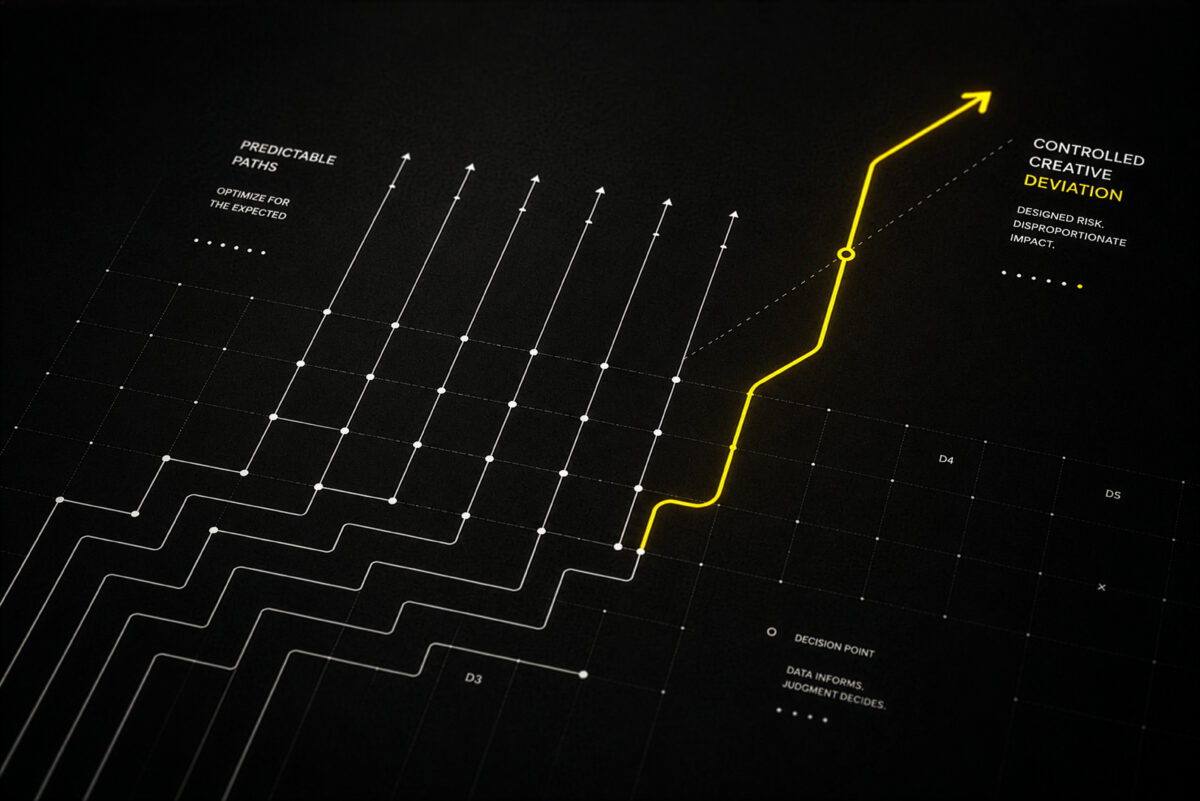
What the industry calls data-informed creative direction is, in practice, often data-limited creative direction. Evidence frames the problem. Judgment should answer it. The moment of creative departure, the point where a team deliberately moves beyond what category data approves, has to be a conscious and protected decision. Not an accident. Not a failure of process. A designed move.
This is what I call Controlled Creative Deviation: the point where evidence has clarified the problem, but creative judgment deliberately departs from predictable category logic to produce something more memorable.
The decision-design problem
Most briefing and approval systems still treat creativity as either free expression or controlled execution. Very few are designed for the more difficult space between: evidence-informed creative risk.
This is not only a creative problem. It is a decision-design problem. Leaders often ask for bold work while designing approval systems that punish deviation. Then they wonder why the final output looks like everyone else’s. The problem is rarely a lack of creative talent. It is the absence of a system that protects creative judgment at the moment it becomes uncomfortable.
Bold work does not survive by accident. It survives because someone in a position of leadership decided to protect the deviation rather than eliminate it.
What we actually need now
The old model: trust your gut, defend it with authority. The current model: trust the data, defend it with metrics. Both have the same structural problem. They treat one input as the whole answer.
What a mature creative process needs is a third approach. One that uses research to identify the problem precisely, then gives creative judgment the room to answer it unexpectedly. Not data versus instinct. Data to frame the question, judgment to answer it in a way the data could not predict.
That requires new briefing structures, new approval logic, and a different understanding of what creative leadership actually is. The most interesting work happening right now lives in the tension between evidence and deliberate deviation. It is uncomfortable. It is not efficient. It does not produce the kind of output that reads well in a performance report.
But it is the only kind of work that is genuinely hard to copy.