By mid-afternoon, the room had heard every voice in it.
That had been the point. A cross-functional leadership group had come together to make sense of a strategic question that no single function could answer alone. Each part of the organisation saw a different piece of it. The design was deliberate: every person would build their own view, and every person would explain it before anyone started converging. Nobody would be talked over. Nobody would be left out for being junior, quiet, or fluent in a different professional language.
And it worked, in the way it was meant to. Perspectives surfaced that would never have made it into a slide deck. Dependencies appeared that nobody had mapped. For the first stretch of the day, the energy in the room was the energy of people discovering they had been looking at different parts of the same thing.
Then something slower set in. Explanations grew longer. People re-explained points that had already landed, sometimes their own, sometimes someone else's. Questions reopened contributions instead of clarifying them. By the time the group needed to converge, the room was tired, and tired groups do not choose well.
Nobody had been excluded. Everyone had been heard. The session still lost momentum at exactly the point where it needed it most.
The comfortable definition of inclusion
Most organisations that care about an inclusive team culture translate it into a rule about airtime. Make sure everyone gets the floor. Go round the table. Invite the quiet ones in. These are good instincts, and in rooms shaped by hierarchy they are necessary corrections.
The problem is what the rule quietly leaves out. It treats inclusion as a quantity, measured in minutes, rather than as a property of how contributions shape the outcome. A meeting can give every participant ten minutes and still be decided by the two people who speak last, or loudest, or with the most authority once the round is over.
The airtime rule also creates its own pressure. When the floor is guaranteed and time is equal, people fill it. They explain the context before the point, then the point, then the reasons behind the point. Usually this is not ego. It is a reasonable fear that if they do not say everything now, the moment will not come back.
That fear is a cultural signal. It tells you that people do not trust the system to return to their contribution later, so they front-load everything into the one slot they are sure of.
I have argued before that teams shape culture more than leaders do. This is one of the places where it shows. No leader declares that contributions must be exhaustive. The team learns it, meeting by meeting, from how often a point once made is actually picked up again.
What an inclusive team culture actually distributes

If airtime is the wrong unit, what is the right one?
The most useful evidence I know comes from research on collective intelligence. Anita Woolley and colleagues at Carnegie Mellon and MIT studied groups working across a wide range of tasks and found that a group's performance was not well predicted by the intelligence of its individual members. What did predict it included how evenly conversational turns were distributed. Groups in which a few people dominated the conversation performed worse.
The detail that matters is the unit of measurement. The researchers looked at turns, not speeches. A group where everyone takes many short turns behaves very differently from a group where everyone delivers one long monologue, even if the minutes per person are identical. The first is a conversation. The second is a sequence of presentations.
That distinction changes the design question. An inclusive team culture does not need to guarantee that everyone talks for the same amount of time. It needs to guarantee that everyone can come back in, often and briefly, and that what they said will be built on rather than set aside.
Influence lives in the ability to re-enter. Airtime without re-entry is a performance.
Why brevity needs structure, not discipline
The obvious response is to ask people to be concise. It rarely works, because brevity is not a matter of personal discipline. It is a matter of trust in the structure.
Back in the room, the pattern was easy to see once I looked for it. The longest explanations tended to come with the most literal models. When someone had built an accurate picture of a process, the only way to make it mean something was to narrate it step by step. The model could not speak for itself, so the speaker had to. Nobody in that moment was taking too much space out of self-importance. They were compensating for a structure that had not yet given them a better way to be understood.
People are brief when three conditions hold. They know their contribution is captured somewhere other than in their own spoken words. They know there will be another turn. And they know that questions will be used to understand them, not to cross-examine them. Remove any one of those and people lengthen their contributions to compensate.
This connects to something I wrote about why strategy needs diverse thinking. Cognitive diversity only produces better strategy if the differences can actually meet. Long, parallel explanations keep differences side by side. Short, repeated turns let them collide, which is where the value is.
The model does the talking
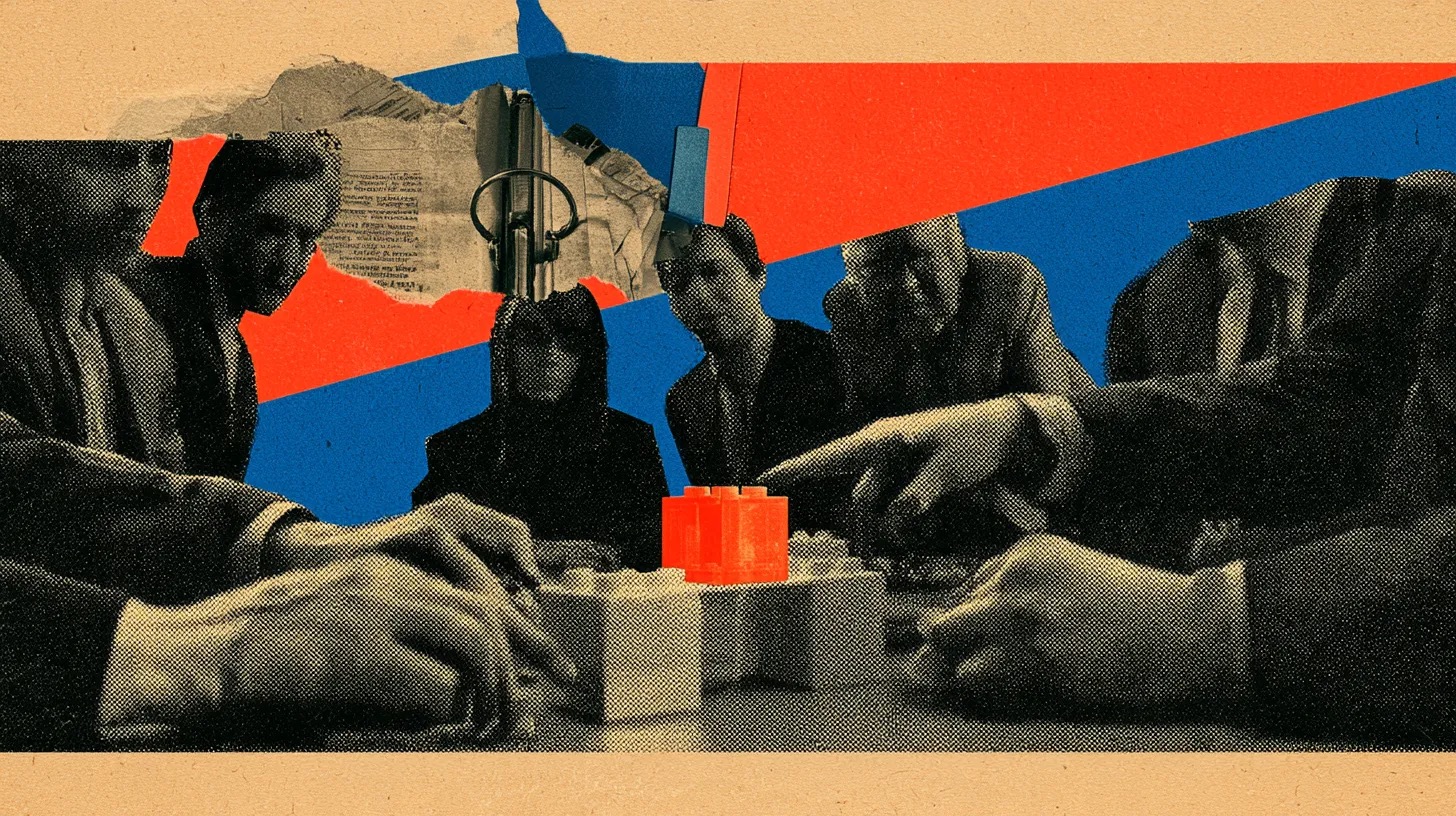
This is where LEGO® SERIOUS PLAY® earns its place, and also where it can go wrong.
The method guarantees participation by design. Everyone builds, and everyone shares the story of what they built. In a hierarchical room, that rule alone shifts the balance. Yet the same rule can reproduce the airtime problem if the facilitator treats the story as the contribution.
It is not. The model is the contribution, and the story is a short guided tour of it. Because the meaning sits in the bricks on the table, it does not have to be carried entirely in speech, and it does not disappear when the speaker stops talking. It stays visible, and anyone can point at it twenty minutes later. That is the structural condition for brevity: the contribution is captured outside the speaker.
The lessons from that afternoon were practical. Story limits need to be short and stated up front, so nobody has to guess how long is acceptable. Questions from others should clarify meaning, or the relationship between two models, rather than reopen every contribution. Participants new to metaphor need a simple instruction early on: build to think, not to illustrate. A literal model needs a long explanation. A metaphorical one carries its own weight.
None of this means imposing rigid limits on everything. Some contributions are emotionally sensitive or unusually complex, and they deserve more time. The facilitator's job is to extend those openly and shorten others openly, so that the exception is visible rather than taken.
Designing brevity into everyday team culture
Workshops make this visible because they compress weeks of team behaviour into a single day. The same pattern runs through ordinary meetings, though, and it can be designed there too.
Start by checking where contributions live. If the only record of what someone said is the memory of the people who heard it, expect people to over-explain. A shared visual, a physical model, or even a single written line per contribution changes the incentive.
Then look at turn structure rather than turn length. A round where everyone speaks once is a ritual. A sequence where people speak briefly, listen, and come back is a conversation. The second needs more facilitation, not less, but it produces decisions the group actually owns.
Watch how questions are used. In many teams, a question after a contribution is a polite form of disagreement. Making clarifying questions an explicit step that comes before any challenge lowers the cost of being brief, because a short contribution will not be misread and then attacked.
Treat repetition as a signal about the system rather than about the person. When people restate points that have already landed, they are telling you they are not sure the point was kept. The fix is in the structure, not in a reminder to be concise.
The last hour belongs to the decision
Design around energy as well. Long sessions punish late contributors, who end up speaking to a tired room. If the agenda requires deep convergence at the end, protect time and attention for it rather than hoping enough will be left over.
An inclusive team culture is not one where everyone talks equally. It is one where nobody has to say everything at once, because they trust the team to come back to them.
In your last important team meeting, did people speak briefly because they trusted their point would be picked up again, or at length because they were not sure it would be?