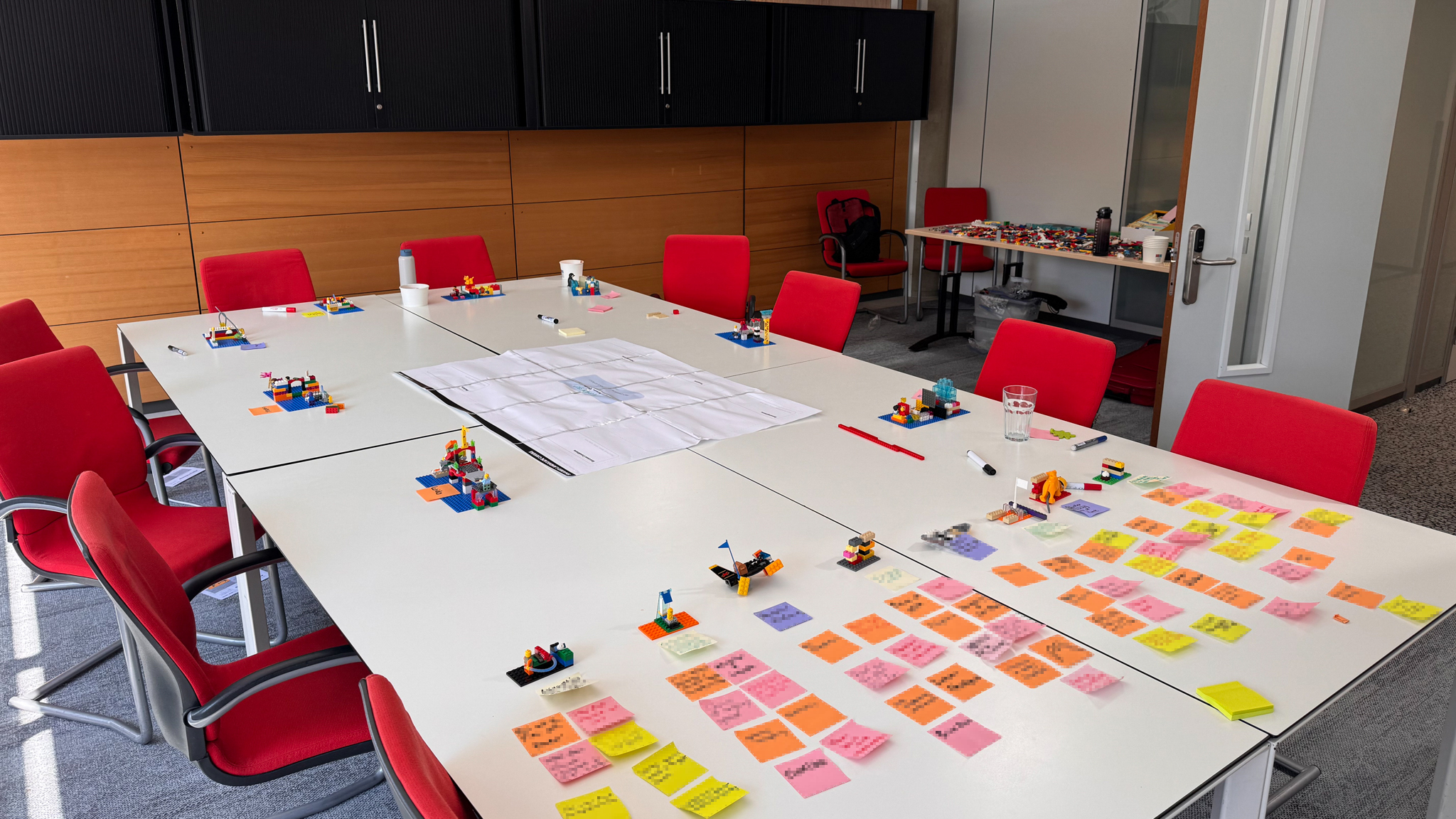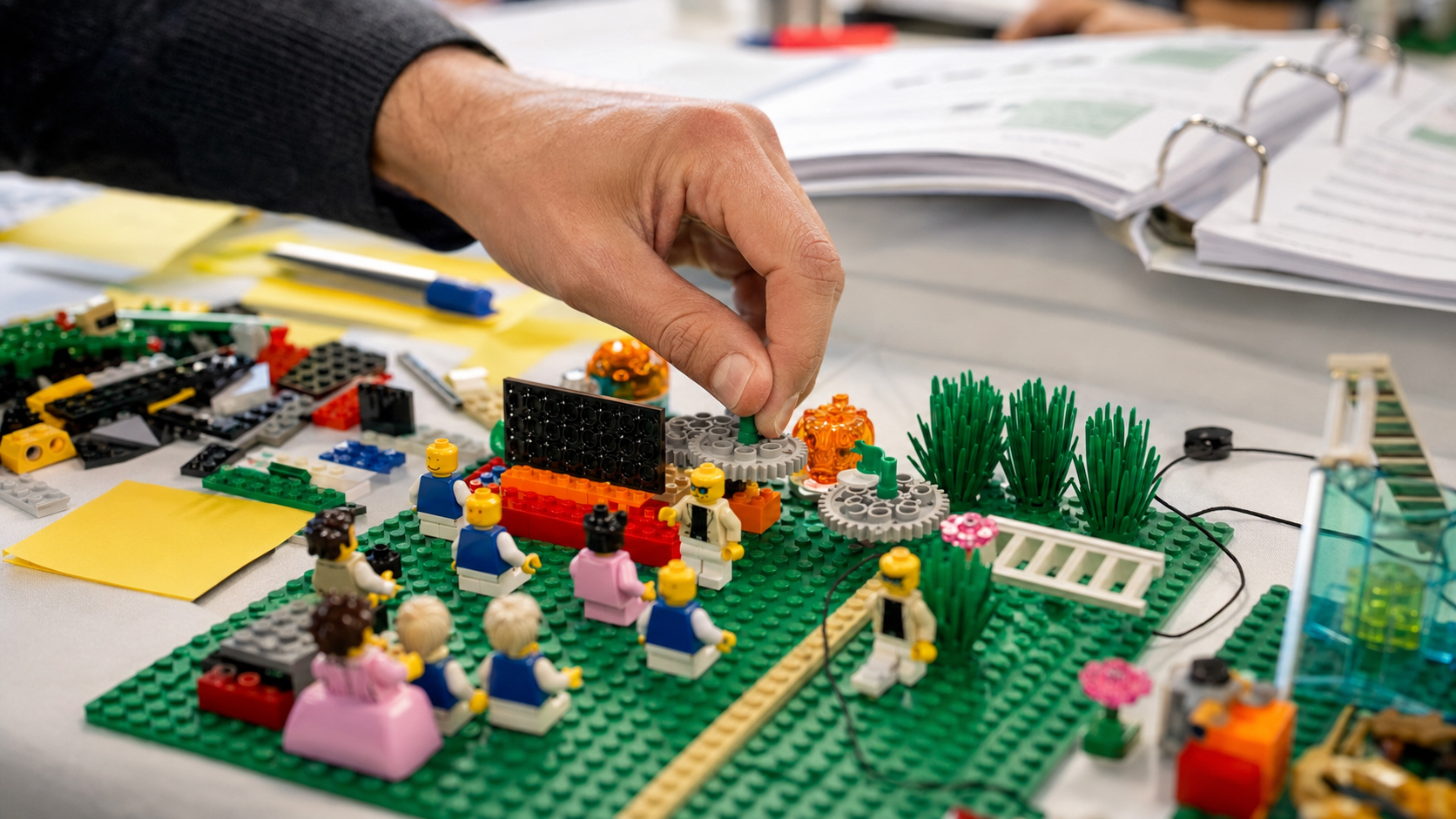
Ask a student to explain what their model represents and they will describe their concept.
Ask them to explain the metaphor they chose, and something else happens. They often interrupt themselves. The metaphor carries an assumption they had not noticed they were making, and hearing themselves say it out loud is the first time they see it.
Then the questions start. Questions from me, and from the other students in the room. In my sessions this has produced two things, repeatedly. Alternative solutions to a problem the team thought it had already settled. And the quiet death of an experiment the team came in planning to run.
Killing an experiment before it consumes two weeks is not a soft outcome. In a ten week course it is close to the most valuable thing that can happen in an hour.
This article is about why that happens, and what a course has to be designed to do with it. I coordinate Innovation Leadership at HU Hogeschool Utrecht, where student teams develop an opportunity into a business concept. The course runs ten weeks, seven of which carry lectures, skill labs and consultation sessions. That is the setting the observations come from. The problem underneath them is not specific to education, which is the part worth staying for.
What a shared artefact hides
Here is the problem with project-based teaching.
A team produces something together. A canvas, a stakeholder map, a deck. That artefact proves they worked together. It does not prove they think the same thing. It does not prove any one of them can defend the reasoning underneath it.
An artefact is the result of a negotiation. Someone proposed, someone objected, someone conceded, and what survived got drawn. The drawing is what gets assessed. The negotiation is where the learning happened, and it left no trace.
So the educator assesses the output and infers the thinking. That inference is usually wrong.
LEGO Serious Play reverses the order, and that reversal is the whole of its educational value.
The real case for it is not engagement
The usual argument for the method in a classroom is engagement. Students participate. Quieter voices contribute. The room comes alive.
That argument is true. It is also the weakest reason to use it. Engagement is easy to produce and almost impossible to assess.
The stronger argument is about cost. Every assumption a team holds gets tested eventually. The only question is when, and what has already been spent by then.
Explaining a model costs a few minutes. Being questioned on it costs nothing at all. Discovering the same flaw four weeks later, after a prototype and a round of user testing, costs the rest of the project.
The method moves the test to the front. That is the whole mechanism.
But it only pays off if the course does something with what surfaces. This is where most integrations fail. And that failure is a design failure, not a facilitation failure.
Individual first, shared second
The sequence is not decoration.
A facilitator poses a challenge. Each person builds their own response. Each explains what their model means. Questions follow. Only then does the group build something shared.
Collapse that sequence and you have a craft activity with good materials. The individual build and the individual explanation are the parts that get cut when time is short, which is the argument I made in why LEGO Serious Play resists the facilitation shortcut.
In ecosystem work I open with dependence rather than description. Build the relationship your innovation would struggle most to survive without.
Answering on their own, students have named partners they had never put on their map. They have named knowledge the team was missing, rather than knowledge it disagreed about.
Their shared map could not have contained any of it. A shared map records what a group already agreed to draw. It is a poor instrument for finding what nobody thought to propose.
The first round of questions is already a test
Opportunity discovery is where this earns its place in the schedule.
Students build their current understanding of an unmet need. They explain what they think causes it. Then they separate two things that usually sit together unexamined: what customers have actually said or done, and what the team has inferred.
A model of a customer problem is just the team’s account of that problem. Nothing more. It becomes useful when it shows them what evidence they are missing, and sends them to the people who have it.
In practice the first round of questions works as a first test of the riskiest assumption. It is not a substitute for talking to customers and nobody should pretend it is. It is a filter, applied before anyone spends real time on a real experiment.
Students have left that round having collected initial feedback on the assumption they were most exposed to. Some have abandoned the test they arrived intending to run.
Organisations have the same problem, at a larger scale and with more money attached. That is where innovation teams’ inability to think together does its damage. The difference in a course is that each student also has to explain how the evidence changed their own judgement, not just the team’s direction.
What the research supports, and what it does not
Sean McCusker studied a workshop on International Education with participants of mixed background, language and seniority. He found the method supported equality of voice in that setting.
That is a finding about participation in one room. It is not a finding about learning outcomes and should not be cited as one. McCusker, 2020.
The distinction matters. Equal opportunity to speak is not equal opportunity to influence. If every student explains a model and the team then adopts its usual spokesperson’s reading of the problem, the exercise changed the seating and nothing else.
Claire Garden’s work in cell biology teaching is the more useful case for educators, because her subject has right answers. Facilitation there helped students correct factual errors in their own explanations while keeping attention on the material. The study ran with 26 participants and 21 completed evaluations. It also identified accessibility barriers, and recommended giving advance information about the activity and offering alternative materials. Evaluation happened immediately afterwards, and the authors were clear that longer-term effects still need investigation. Garden, 2022.
Alan Wheeler ran sessions across politics, nursing and law at Middlesex University. His account is worth reading mainly for its warning. He cautions against treating the method as an educational cure-all, and notes the risk of it becoming the next big thing before being dropped. He also separates the specific method from general playfulness, which most enthusiastic write-ups skip. Wheeler, 2023.
There is a line the educator has to hold here.
The builder owns what the model represents. A tower might mean ambition, or isolation, or nothing much. Its appearance gives nobody licence to diagnose the student.
Once the student has explained it, though, the claims inside that explanation are open to scrutiny like any other claim. A student may decide a wall represents customer distrust. Whether distrust is the actual barrier is a research question.
Respecting the metaphor and questioning the reasoning are not in tension. They are different jobs.
Putting it into a curriculum
For anyone designing or revising a programme, the question is not whether the method works. It is where it belongs and what it replaces.A build round is expensive in contact hours. It has to displace something. A course already carrying maps, canvases, prototypes and experiments gains nothing from one more activity whose output is never used again.
I place it at four points where a conversation has to happen anyway and usually happens badly.
Concept formation, where disagreement is cheapest to resolve.
Assumption selection, right before a team commits to a test, because that is the decision with the highest cost of being wrong.
Post-feedback revision, where students have to say which connection changed and which expectation failed, instead of quietly redrawing the map.
Individual reflection, where a student accounts for a decision they contributed to and how they handled disagreement.
That fourth one solves a problem project-based curricula have anyway. Group assessment struggles to evidence individual reasoning. An individual model plus a recorded individual explanation is assessable evidence, tied to a specific moment rather than a general claim about being collaborative. It works well in an oral exam.
Before an expert feedback session, teams can use their models to rehearse an account of their dependencies and open risks rather than a pitch. Photographs only carry that forward if they travel with the builder’s explanation and the experiment results. On their own they are souvenirs.
Preparation has to include accessible routes into the activity. Advance information about what the session involves, and alternative materials where needed, following Garden’s findings. That is a design requirement, not a courtesy.
And the honest limit. Enjoyment is not attainment. If the question you ask afterwards is whether students liked it, the answer will be yes, and it will tell you nothing.
Better questions to ask afterwards
Can students explain a dependency more precisely than they could before?
Can they tell an assumption from evidence, choose a test that fits the claim, and show what the result did to their concept?
Can each of them account for their own contribution without hiding inside the team’s?
Did any team stop an experiment it no longer needed to run?
Those questions connect the method to the point of the course. They also connect a classroom to something larger. The routines around contribution, questioning and revision decide which ideas get attention, and how a group responds when its reasoning turns out to be wrong.
That is true of a student team with a stakeholder map. It is true of an executive team with a strategy deck. Both produce artefacts that look like agreement. Both are usually wrong about how much agreement is underneath.
The method makes the difference visible. Whether anything happens next is a matter of design.
When every student has shared their model, what does your course do with the thinking it has made visible?
Christian Vernaschi designs leadership and decision systems for organisations in the Netherlands and the DACH region, and coordinates the Innovation Leadership course at HU Hogeschool Utrecht. He is a certified LEGO Serious Play facilitator.
For organisations: the work usually starts with how decisions actually get made, not with a workshop. For programme designers considering an integration like the one above, I am happy to compare notes.