Most facilitation can be templated. This method can't.
Every workshop deck looks the same now. Sticky notes, a Miro board, three rounds of “how might we,” a dot-voting exercise, a photo of the wall at the end. Swap the logo and you can’t tell a brand sprint from a sustainability offsite from a leadership retreat. The exercises are interchangeable because they were designed to be. That’s not a criticism of Design Thinking itself. It’s what happens to any method once it gets compressed into a template that can run without the person who understands why the steps exist. LEGO Serious Play facilitation is one of the few practices left that hasn’t been fully templated, and the reason is structural, not sentimental.
Facilitation as a discipline has quietly absorbed the same arc. Design thinking was born as a way to force specificity onto fuzzy problems, then flattened over a decade into what MIT Technology Review has described as innovation theater, a sequence of boxes checked without anything actually shifting inside the organisation. Facilitation is following the identical path, one sticky note at a time.
Open LinkedIn on any given day and count the consulting postings advertising “strategic facilitation” as a core capability. Most come from firms large enough that the person actually running your session has led maybe three workshops in their career, dropped into your building with a laptop and an agenda handed down from someone more senior. The firm still charges full rates, not because that junior consultant is solving your specific problem, but because the firm’s name, its sales team, and its case study slide are doing the selling instead of the facilitator.
Mazzucato and Collington documented this exact substitution at scale in The Big Con:
brand and sales infrastructure standing in for specific expertise, priced as if the expertise were still there. As a result, the client experiences motion, energy, a wall full of colored paper, and calls it alignment. Three months later they’re paying a similar invoice for the same exercise under a different logo, wondering why nothing moved.
LEGO® Serious Play® facilitation doesn’t survive that compression. Not because it’s precious about tradition, but because the method’s actual mechanism breaks the moment you skip the step that makes it slow.
The step nobody templates
The core move in LEGO Serious Play facilitation isn’t building a model. It’s building a metaphor under time pressure and then being asked to explain what it means, out loud, to people who can push back on the explanation. That explanation is where the real thinking happens. The model is just the excuse to get someone to say something they hadn’t fully formed yet, and then defend it in front of colleagues who are allowed to disagree.
A sticky note doesn’t require that. You write “improve communication,” you stick it on the wall, nobody asks you what the model of a bridge with a broken plank is actually standing in for, or why you built the plank broken instead of missing. The metaphor forces a specificity that abstract language lets you avoid entirely. That’s the whole value of the method, and it’s also exactly the part a template can’t reproduce, because it depends on a facilitator who knows how to press on an answer without leading the person toward a predetermined one.
What that looks like in practice
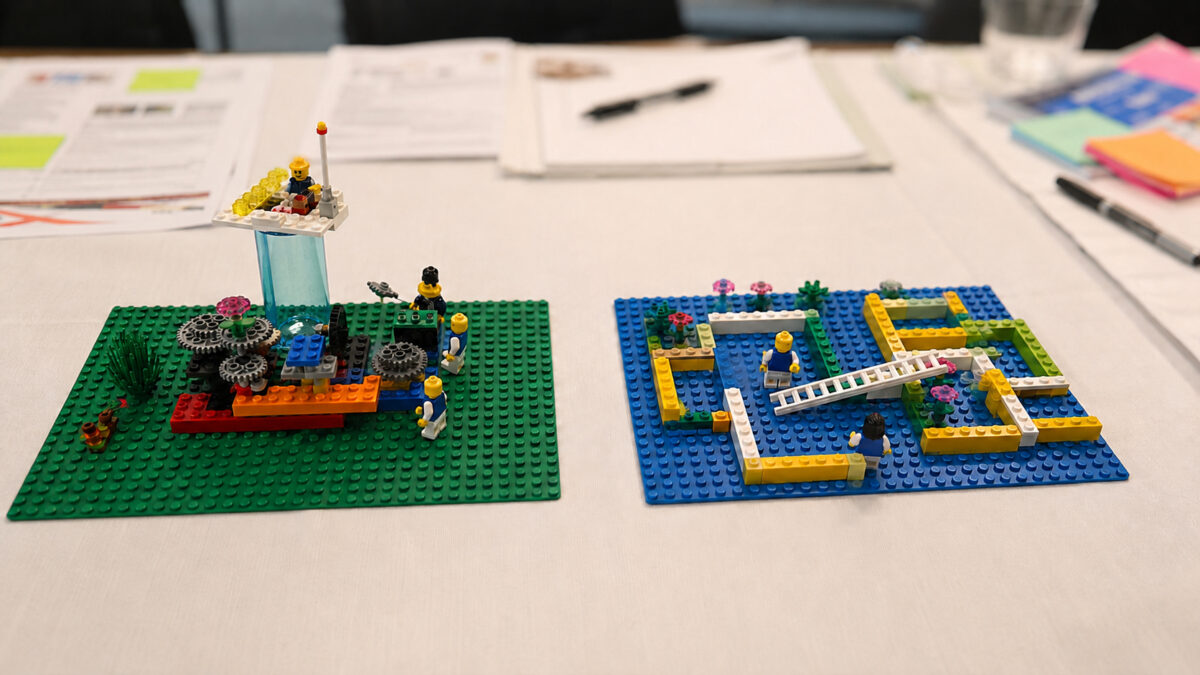
Picture two people separately asked to build a model of how their team makes decisions. One builds a control tower with a clear sightline to every department. The other builds a maze with a single narrow bridge in the middle. On a sticky note, both might have written the identical phrase: improve decision speed. The moment they’re asked to explain the model out loud, however, the actual disagreement surfaces immediately, because a control tower and a narrow bridge through a maze are not describing the same problem, let alone the same fix. That gap was always sitting between them. The sticky note just never asked either one to make it visible.
This is the same load-bearing logic behind why brand differentiation collapses when the organisation can’t carry it. A method that looks identical from the outside can be structurally hollow on the inside, and the gap only shows up under load, when someone has to actually defend a position instead of performing one.
Why LEGO Serious Play facilitation gets shortcut anyway
Facilitators shortcut LEGO Serious Play facilitation for the same reason anyone templates anything: it’s cheaper to deliver and easier to sell. Skip the individual build-and-share round, replace real probing questions with a scripted debrief, and you can run “LEGO Serious Play” inside almost any slot on a client’s calendar. The client still gets bricks on a table and a good photo. What they don’t get is the part where disagreement actually surfaces, because that requires the mechanism working properly, not a specific number of hours.
This isn’t an argument against short sessions. A four-hour taste of the method, or even a single exercise built to introduce the underlying idea, can be genuinely useful, and I run both regularly depending on what a client actually needs. The difference is what gets promised against what gets delivered. A single exercise sold honestly as an introduction does exactly its job. The same exercise sold as if it produced full team alignment is where the shortcut turns into the con. The failure was never the compressed agenda. It’s a compressed agenda marketed as the full outcome.
The failure isn’t a short session. It’s a short session sold as a long one.
That mismatch is the same pattern as teams that can’t actually think together even when the room looked collaborative. The exercise ran on schedule. Nothing else did.
What resists the shortcut
Two things in the method don’t compress without breaking it, regardless of how long the session runs. The individual build-and-share round, where every person has to construct and defend their own model before the group builds anything together. And the facilitator’s questioning technique, which has to probe a metaphor without supplying the answer the facilitator wants to hear. Both fit inside a single hour or inside two full days. Neither fits inside a scripted debrief, no matter how the agenda is dressed up.
Cut either one and you’re running a building exercise with LEGO bricks. Keep both, at whatever duration honestly matches the outcome you’re promising, and you’re running the method.
What honest scoping sounds like
In practice this changes what a facilitator says about LEGO Serious Play facilitation in the sales conversation, not just what happens in the room. Framed honestly, a single ninety-minute exercise sounds like this: it will show your team what the method feels like and surface one live tension, it will not produce a finished strategy. A four-hour session sounds different: it can move one specific decision forward, with the individual build-and-share round left intact, but it still isn’t the full alignment process. Give it two full days, and the promise changes again: it’s now built to carry the full weight of aligning a team around a shared model, with enough time for the friction to actually surface and get worked through.
None of these is a lesser version of the others. They’re different tools scoped to different jobs, and a good facilitator should be able to name which one a client actually needs instead of selling whichever one is on the standard rate card. The dishonesty only enters when a ninety-minute exercise gets sold with the language reserved for the two-day version. That’s where a client pays full-alignment money for a taste test, and doesn’t find out until the “aligned” team turns out to have three different interpretations of what they built.
What this actually protects
None of this means the method is fragile. It means it’s honest about what it requires, in a market that mostly rewards facilitation for pretending it requires nothing, or for pretending that any duration produces the same depth of outcome regardless of what actually happens inside it. A workshop that can be fully templated, at any length, was probably never doing the specific job it claimed to do in the first place.
That honesty is also what a large firm’s scale can’t buy back. You can staff a room with more junior consultants. What you can’t shortcut is the minute where someone has to defend a metaphor they didn’t see coming, because that minute depends on the person running it, not the logo on the deck.
If you’re evaluating LEGO Serious Play facilitation, or your own workshop practice, the question isn’t whether the session used LEGO bricks, or how many hours it ran. It’s whether anyone in the room was asked to defend a metaphor they hadn’t fully thought through yet, whether the facilitator knew how to press on the answer without supplying it, and whether what was promised matched what the format could actually deliver.