
Brand differentiation is usually treated as a branding problem. In practice, it is often an organisational proof problem.
There is a specific moment in brand strategy work that feels like progress but isn’t. The team has been in the room for three hours. The positioning is sharper. The territory is mapped. The language finally feels distinctive. Someone says it out loud: “We sound different now.” And they’re right. They do.
What hasn’t been asked yet is whether the organisation can behave differently long enough for anyone outside the room to believe it.
That gap between what the brand claims and what the organisation can actually carry is where most differentiation work quietly fails.
The problem is not differentiation. It is proof.
Most companies don’t have a differentiation problem at the level they think they do. They have a proof problem.
They want to be seen as more human, more innovative, more sustainable, more agile, more customer-first. The vocabulary arrives quickly and confidently. The problem is that these words usually describe ambition, not behaviour.
The website says “human” but the service experience is automated, slow, and slightly hostile. The brand says “innovative” but internal decision-making punishes anything that creates uncertainty. The purpose statement says “sustainable” but sustainability is a campaign theme, not a business constraint. The positioning says “bold” but every approval process quietly rewards the safest version of the idea.
This is not a communication gap. It is a structural gap. The brand is promising something the organisation has not yet learned to consistently deliver.
Brand differentiation is load-bearing
It helps to think of differentiation as a load-bearing system rather than a finishing layer.
The visible brand difference is what the market encounters: the message, the tone, the product experience, the service model, the digital interface, the way a team member handles a difficult moment. This visible layer matters. But it is not where differentiation begins.
Underneath it sit the real structures: decisions, behaviours, operating model, culture, service choices, product trade-offs, and the way teams interpret priorities when nobody is in the room to explain the strategy again. If those layers cannot carry the weight, the visible difference becomes decoration. Sometimes expensive decoration. Still decoration.
A brand does not become different because it says something original once. It becomes different when the same meaningful difference becomes visible again and again, across enough touchpoints, over enough time, with enough consistency that people start to believe it.
Three questions before you commit to a differentiator
Not all differences are worth building around. Before committing, three questions need honest answers. Each one exposes a different type of weakness.
Can you prove it exists? The difference must live in behaviour, not language. Not in the About page, not in the values workshop output, not in the brand book. It has to show up in what the organisation actually does: service design, product decisions, pricing logic, hiring choices, or how a team handles a difficult client moment. If you can’t point to it in practice, it isn’t a differentiator yet. It’s an intention.
Can you defend it under pressure? A difference that holds in normal conditions but collapses when budgets tighten, timelines compress, or a competitor reacts is not a strategic advantage. It is a nice-weather position. The real test arrives when a client asks for an exception, a leader gets nervous, or short-term revenue pulls in the opposite direction. If the organisation hasn’t decided in advance what must be protected, the difference will leak. Gradually, invisibly, and then all at once.
Does anyone outside the building care? Organisations are skilled at becoming fascinated by themselves: their methods, history, internal language, and unique approach. Some of it may be valuable. Some of it is noise. The customer decides. A difference becomes meaningful only when it connects to something people recognise in their own experience: a frustration, an aspiration, a belief, or a job they need done. Without that connection, the organisation may be different. It is not differentiated.
There is a gap between those two things. Worth sitting with.
Standing out is not the same as being chosen
The common misread is that differentiation is mainly about visibility. That is only part of it.
Visibility gets attention. Brand differentiation changes behaviour. Many brands confuse distinctiveness with differentiation: they become louder, cleaner, bolder, more expressive, more ownable. Distinctive assets matter. Design matters. Memory structures matter. But being recognisable is not the same as being chosen.
The deeper question is not whether people notice the brand. It is whether they understand why its difference matters enough to act on it.
Customers reward differences that make their world easier, safer, clearer, or more aligned with who they are. Not every internal difference qualifies. The brand team may love the founder story. Leadership may love the purpose statement. The product team may love the technical nuance. The customer may not care.
Cruel, but efficient.
Strong brands turn differentiation into behaviour
The brands hardest to copy don’t rely on a single surface-level claim. Their difference is carried by multiple layers of the organisation.
Patagonia doesn’t hold its position because it talks about environmental responsibility. Many brands do that now, some with impressive confidence while doing very little, which is almost a talent. Patagonia’s difference carries weight because repair, reuse, and product longevity are connected to business behaviour, not just brand language. Through its Worn Wear programme, the sustainability claim becomes something customers can experience, not just read.
Apple’s retail environment works differently. The Apple Store is not only a place to buy devices. The Genius Bar and Today at Apple turn the store into a support, learning, and service layer, not a distribution channel. As a result, the experience becomes part of the brand system. It carries the difference visibly.
Aldi is useful because there is very little romance in it, which is exactly why it works. Its differentiation is not built around premium positioning. It is built around operational simplicity, private-label control, and a shopping experience designed to reduce complexity. Every decision reinforces the same position: from the quarter-deposit cart to the absence of dedicated baggers. No gap between the claim and the shelf.
These examples are different in almost every way. The mechanism is the same. The brand promise is not floating above the business. It is carried by it.
Brand differentiation fails when it starts too late
Many brand strategy processes disappoint because differentiation is treated as something to define after the real business choices have already been made.
The business model is fixed. The service model is accepted. The culture is tolerated. The decision-making patterns are normalised. The customer experience is fragmented. Then someone asks the brand to make it all feel distinctive.
This is where branding becomes theatrical.
A team gathers. They define values, map territories, debate tone, choose a direction, and leave with energy. Then the organisation continues behaving almost exactly as before. The vocabulary changes. The decision patterns do not. Differentiation starts to leak: not through one dramatic failure, but through small compromises that slowly pull the brand back toward the category average.
This is why brand strategy is less an expression exercise than a decision-design exercise. If the brand claims “radically simple”, what decisions must become simpler? If it claims “human”, what must change in service design, hiring, escalation, and onboarding? If it claims “sustainable”, what will the organisation stop doing even when it costs money?
Without those decisions, differentiation stays conceptual. Good in the room. Weak in the market.
What makes a difference credible over time
Answering the three questions above tells you whether a differentiator is worth committing to. Building it is a different problem. That requires three things working together.
Operational proof is what the organisation actually does differently. Not what it claims. Not what it intends. What it does. This proof can live in product quality, service design, delivery model, pricing logic, community rituals, employee empowerment, or any consistent pattern of visible action. Without it, there is no real differentiation. There may be a well-written About page. There is no weight.
Decision consistency is how the organisation protects the difference over time. Differences are easy to define and hard to defend. The pressure arrives when a client asks for an exception, a budget gets cut, a deadline moves, or a leader gets nervous. This is where differentiation either strengthens or leaks. If every team makes different trade-offs, the brand becomes inconsistent: not because people are incompetent, but because the decision architecture is weak. The organisation has not made clear what must be protected, what can flex, and what must be refused.
Customer meaning is whether the difference matters to the people the brand wants to serve. A difference becomes strategic only when it connects to something people recognise as meaningful: a frustration, an aspiration, a belief, a job-to-be-done. Without that connection, the organisation may be different. It is not differentiated.
These three layers are not sequential. They are interdependent. Operational proof without customer meaning is interesting but irrelevant. Decision consistency without operational proof is policy without substance. Customer meaning without either is positioning without a product to back it up. The credibility comes from all three holding at once, under pressure, over time.
Brand strategy needs facilitation, not just expression
This is where the design question becomes concrete.
A good brand strategy process does not exist to produce better language. It exists to create the conditions where teams can examine what they can actually make true: where assumptions become visible, contradictions get tested, and the gap between ambition and operational capacity becomes undeniable before it becomes expensive.
That kind of process requires more than a good brief and a capable moderator. It requires a methodology that makes structural problems visible, not just discussable.
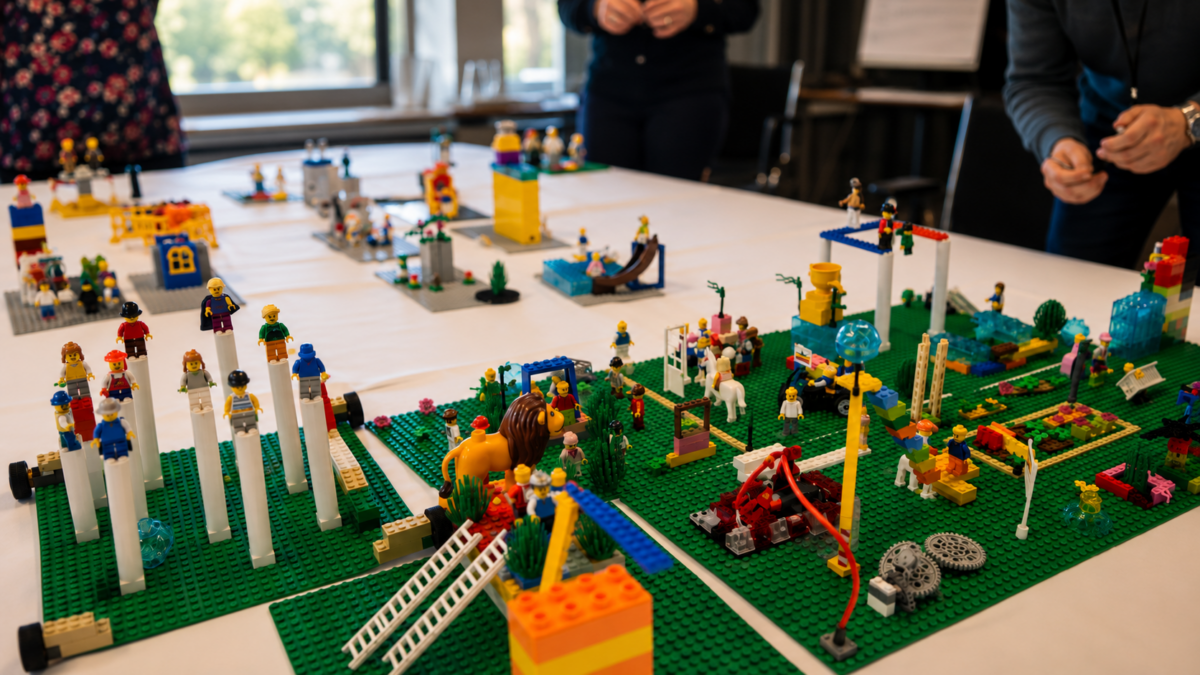
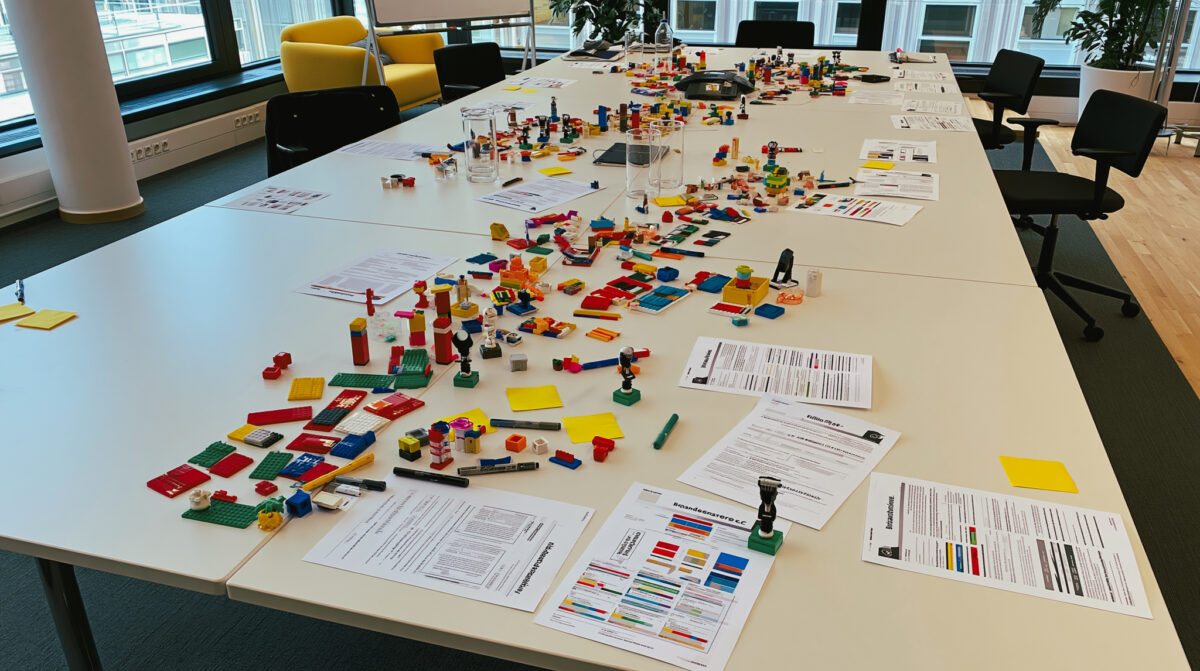
This is where physical modelling changes the work. In a LEGO® Serious Play® session built around brand strategy, teams don’t just describe their organisation: they build it. And a built model either holds or it doesn’t. You cannot construct a load-bearing structure from loose bricks and call it stable. The physical act of building makes the gap between what the brand claims and what the organisation can carry immediately, literally visible. Not as a slide. Not as a discussion. As something you can see collapsing across a table.
That is a different quality of honesty than most strategy sessions produce.
This connects directly to why leadership systems and decision architecture are inseparable from brand work. The task is not only to define a position. It is to design the conditions that make the position believable inside the organisation, before it needs to be believable outside it.
The uncomfortable conclusion
Most brands are not under-differentiated. They are under-supported.
The promise is bigger than the system built to carry it. That is why so much branding feels good in the room and weak in the market. The language improves, but the behaviour does not. The positioning sharpens, but the decisions stay vague. The identity changes, but the customer experience remains familiar.
Real differentiation does not start by asking how the brand should sound. It starts by asking what the organisation can make true: consistently, visibly, meaningfully, and under pressure.
That is much less convenient than a rebrand.
It is also much harder to copy.
And that is the point.
If you’re seeing this pattern in your organisation, it’s worth asking whether you have a communication problem or a structural one. They look similar from the inside. They require very different responses.