Last week I observed a leadership team discussing a new innovation initiative.
The organization had everything most companies assume they need: a strong technology stack, a clear ambition to innovate, and a leadership group with deep experience. On paper, the conditions looked ideal.
Yet the conversation stalled.
Someone proposed an idea. Another raised a concern about timing. A third suggested running a pilot first before committing fully. Gradually the discussion slowed as the room filled with hesitation.
No one openly disagreed, yet no one moved the conversation forward either.
In that moment the real constraint became visible. The team did not lack ideas, technology, or ambition. What they lacked was the ability to think through the problem together.
Innovation rarely fails because organizations run out of ideas. More often, it fails because teams lack the innovation capability to reason through problems collectively.
Innovation is not primarily a technology problem
Much of the public conversation about innovation focuses on technology. Organizations invest heavily in digital platforms, artificial intelligence, and new tools that promise to accelerate progress.
Technology certainly plays an important role. At the same time, research on workplace innovation increasingly points to a different driver. Studies show that innovation performance correlates strongly with leadership capability, collaborative learning, and problem-solving skills within teams. These human and organizational factors often have a greater impact on innovation outcomes than technological investment alone, as highlighted in recent research on workplace innovation performance.
This insight challenges a common assumption. Many organizations believe that adopting the right technology will unlock innovation. In practice, technology tends to amplify existing dynamics rather than transform them.
When new tools are introduced, three things typically increase at the same time: the flow of information, the level of complexity, and the interdependence between teams. As these factors grow, the number of decisions required across the organization increases as well.
Under these conditions, innovation depends less on tools and more on something else entirely: the ability of teams to reason together under uncertainty.
Innovation team capability refers to the ability of a group to frame problems, challenge assumptions, and make decisions collectively.
The hidden constraint in innovation
In many organizations collaboration is treated as something that naturally happens when capable people gather in a room. The logic seems simple: bring smart individuals together, give them a problem, and solutions will emerge.
In practice, the situation is more complex.
Effective collective thinking requires specific capabilities. Yet most leadership teams are never trained in them. Executives spend years learning how to advocate for ideas, defend strategic positions, and present convincing arguments. Far fewer learn how to explore complex problems collaboratively.
This difference becomes critical during innovation discussions.
When leaders focus primarily on advocating positions, conversations revolve around defending viewpoints rather than examining assumptions. Discussions gradually shift from exploration toward persuasion. Over time, this dynamic quietly limits a team’s ability to address complex innovation challenges.
In other words, the real constraint is rarely the technology available to the organization. The constraint is the innovation team capability required to explore uncertainty together.
When teams cannot think together
The symptoms are often easy to recognize.
Strategy discussions typically begin with energy and enthusiasm. Ideas emerge quickly and the conversation appears productive. As the discussion moves closer to decision-making, momentum often slows.
Certain patterns begin to appear. Conversations circle around the same issues. Assumptions remain implicit rather than openly examined. Concerns are softened or left unspoken, and responsibility for decisions becomes ambiguous.
What emerges may look like alignment. In reality it is often something else entirely: a shared hesitation to challenge the thinking that produced the current direction.
As a result, innovation discussions generate interesting ideas, encouraging language, and polished presentation slides. What they fail to produce are clear decisions and structural follow-through.

The capabilities teams are missing
If innovation depends on teams thinking together effectively, what capabilities make that possible?
In practice, three elements consistently determine whether collective thinking leads to meaningful progress.
Collective problem framing
Innovation rarely fails at the solution stage. Instead, it fails because teams never fully align on the underlying problem. Discussions frequently jump directly to potential solutions without exploring the assumptions shaping the question itself.
When members of a leadership team are solving different versions of the problem, their proposed solutions inevitably diverge.
Constructive disagreement
Innovation requires challenging assumptions and exploring alternative perspectives. Research on psychological safety in teams in teams shows that innovation thrives when people feel able to question assumptions and raise concerns without social risk. Yet many leadership teams avoid intellectual conflict. Concerns are softened, critical questions remain implicit, and potential flaws in emerging strategies remain unexplored.
Although this may preserve harmony, it often signals that the conversation has become strategically shallow.
Structured decision-making
Ideas only matter if someone is responsible for turning them into action. Without clear decision structures, innovation discussions accumulate possibilities but produce little follow-through.
Teams leave the room energized yet uncertain about ownership, priorities, or next steps. Over time enthusiasm fades, and the same conversations resurface in future meetings.
Why innovation initiatives quietly stall
These capability gaps explain why many organizations experience a familiar frustration. Strategy workshops generate promising ideas and temporary alignment, yet little changes afterward — a pattern many organizations encounter during strategy and innovation workshops.
The problem is rarely a lack of motivation or commitment.
More often, the underlying decision system was never clarified. Teams discussed ideas before establishing who should decide, how decisions would be made, and how initiatives would move from discussion to execution.
Without that structure, innovation initiatives gradually dissolve into something else: committee discussions, escalating approval chains, or postponed decisions.
From the outside this may appear as organizational inertia. In practice it often reflects a simpler issue. The team was never equipped to work through the problem together.
The role of structured facilitation
This is where structured facilitation becomes relevant, though not always in the way leaders expect.
Facilitation is frequently associated with workshops or creative exercises. Its deeper purpose, however, is to support collective thinking.
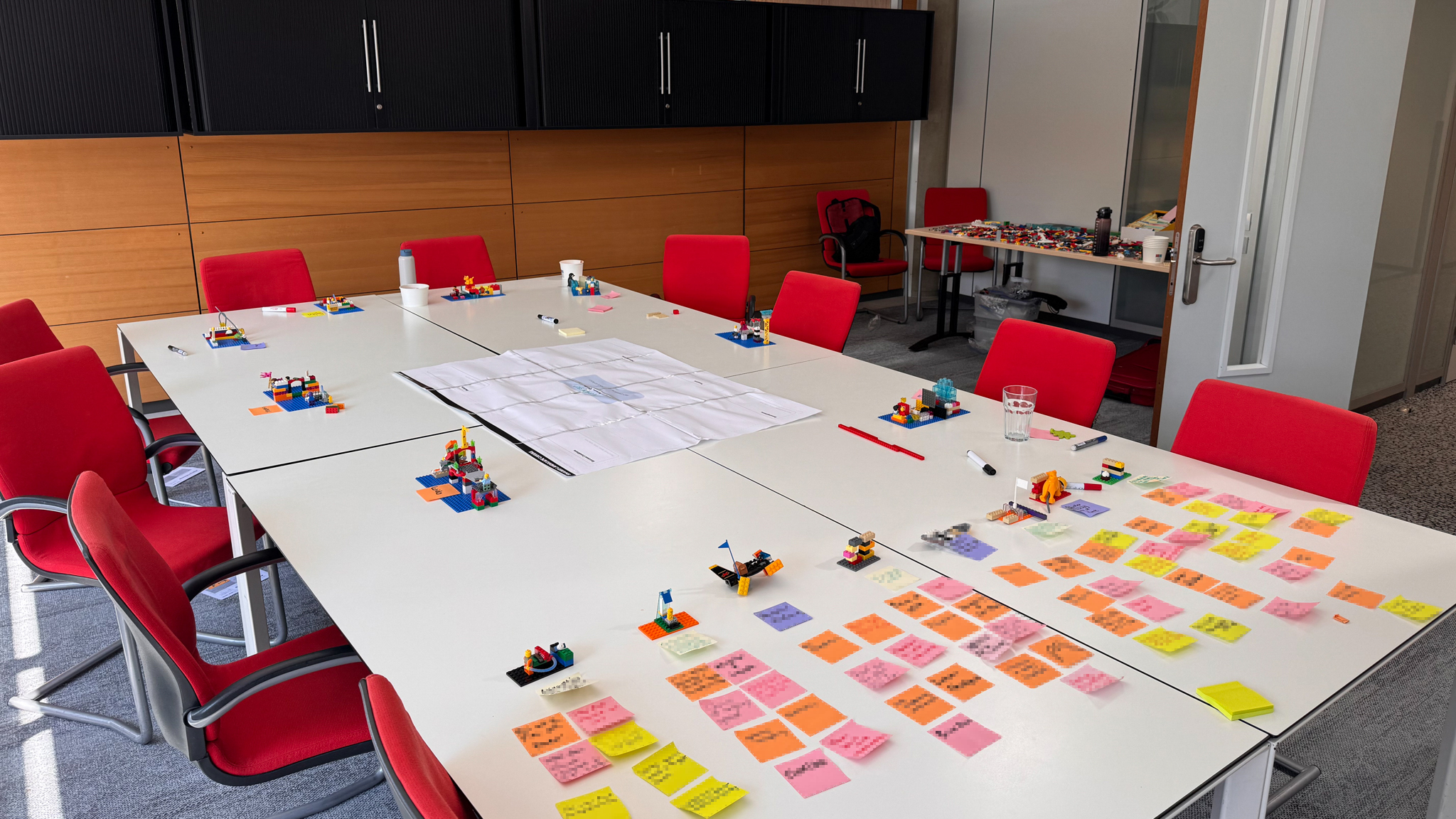
Methods such as LEGO® SeriousPlay® or Design Thinking frameworks developed by the Stanford d.school allow teams to externalize ideas so they can examine them together rather than defend individual viewpoints. When thinking becomes visible, assumptions can be explored more openly and perspectives can be challenged constructively.
As a result, teams are better able to move toward shared understanding and clearer decisions.
In this sense facilitation is not simply about generating creativity. It strengthens the innovation team capability required for groups to think through complex problems together.

Innovation as organizational cognition
For many organizations the real innovation challenge is not generating ideas but creating environments where teams can reason together effectively.
This requires a shift in how leaders understand innovation. Instead of focusing primarily on technology or individual creativity, leaders must pay closer attention to the quality of collective thinking within their organizations.
Innovation behaves less like an individual talent and more like a team-level innovation capability. Research from the MIT Center for Collective Intelligence shows that groups often outperform individuals when they develop effective collective reasoning and decision-making processes. It depends on whether groups can explore uncertainty, challenge assumptions, and move toward shared decisions.
Technology amplifies what teams are already capable of doing. When collaboration is weak, new tools amplify confusion. When teams can think together effectively, technology accelerates progress.
The difference rarely lies in the tools themselves. It lies in the quality of organizational thinking.
Why alignment alone is not enough
When teams struggle to think together, innovation discussions often produce alignment in the moment but little structural follow-through afterward.
The room may feel energized, and the strategy may appear clear while the workshop is taking place. Yet once participants return to their daily responsibilities, ambiguity reappears. Decisions remain unresolved, ownership becomes unclear, and progress slows.
The issue is rarely cultural or motivational. More often it is structural.
Alignment without decision architecture is fragile. Without structures that translate collective thinking into action, even the most promising innovation conversations gradually lose momentum.
Innovation is a collective capability
Organizations often treat innovation as the result of individual creativity or visionary leadership. In practice, innovation functions more like a collective capability.
It depends on whether teams can explore complex questions together and move toward shared decisions.
Technology can support that process, but it cannot replace it. Tools accelerate the dynamics already present inside the organization. If collaboration is fragmented, technology accelerates fragmentation. If teams possess strong innovation team capability, technology amplifies their ability to act.
The real question, therefore, is not simply whether organizations invest in the right technologies. It is whether their teams can think together effectively.
What comes next
When teams cannot think together, innovation discussions often generate ideas but fail to produce decisions. This dynamic explains why many strategy workshops create temporary alignment yet struggle to produce lasting follow-through.
The challenge is rarely enthusiasm or commitment. Instead, it lies in the absence of structures that connect collective thinking with decision-making.
Understanding that difference is often the moment when organizations begin to rethink how strategy and innovation actually work.